
Field Mushroom
Agaricus campestris
Also called meadow mushroom, pink bottom
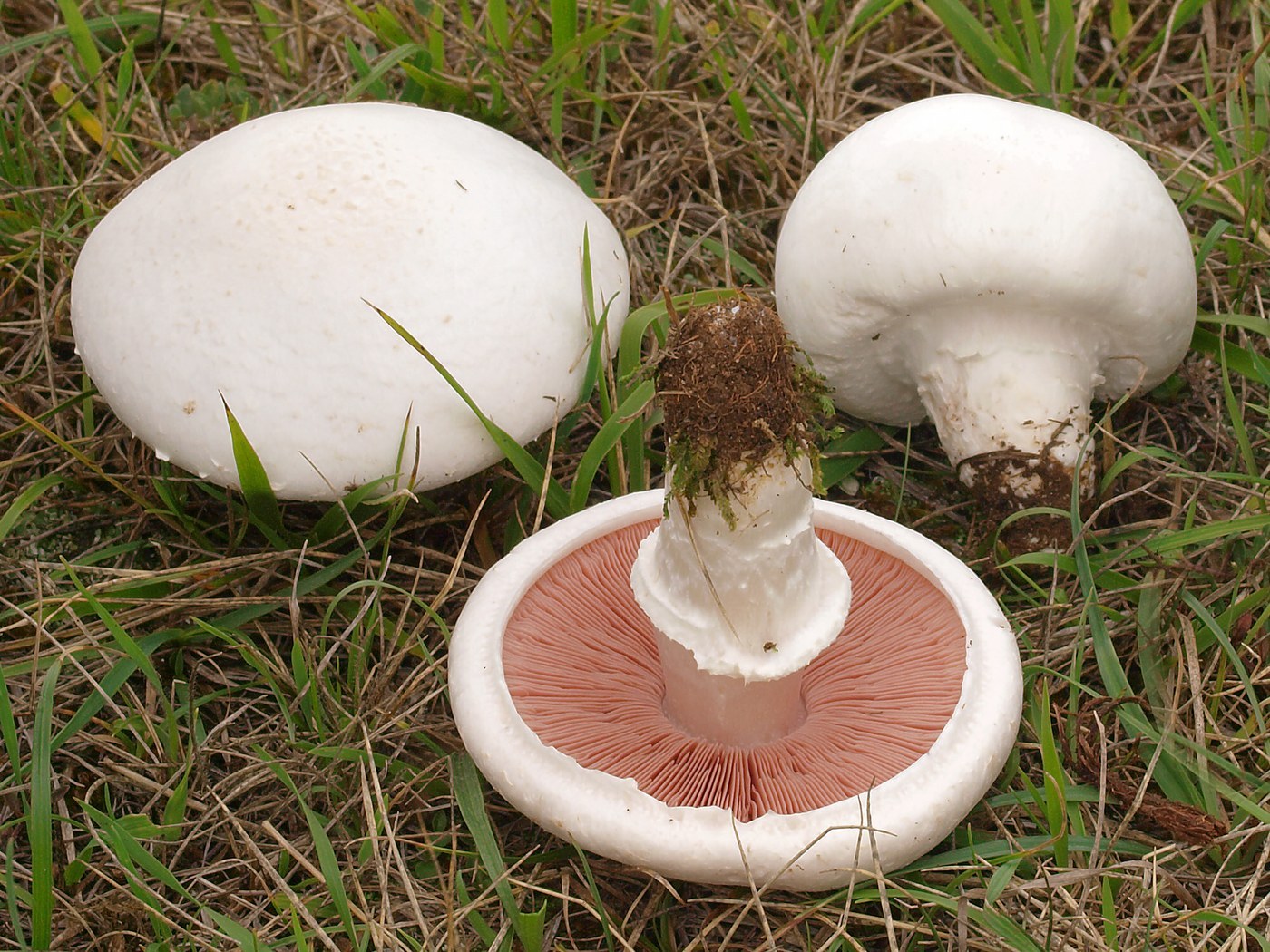
The classic white mushroom of old pasture, with a dry silky cap, a thin fragile ring and gills that are a vivid bright pink when young before turning chocolate-brown. It fruits in troops and rings after rain.
- Group
- Gilled
- Cap
- White, dry, smooth to faintly silky-scaly
- Spore print
- Dark brown
- Habitat
- Grazed pasture, meadows, lawns, dunes
- Season
- Late summer to autumn
Overview
The Field Mushroom is the archetype of its whole genus, and the species that gave Agaricus its name. The genus, in the family Agaricaceae, is defined by free gills that shift from pale through pink to dark chocolate-brown, by a dark brown spore print, and by a partial veil leaving a ring on the stem. It contains several hundred species worldwide, from tiny grassland forms to the giants of hedge bottoms and woodland.
Agaricus campestris sits in the section of non-yellowing, grassland species, sometimes flushing faintly pink where cut but never staining chrome-yellow. It is a fungus of open unimproved grassland, which makes it a good indicator of traditional pasture: it is abundant in old grazed fields, dune grassland and long-established lawns, and has declined sharply in intensively fertilised and reseeded farmland.
Its fame rests partly on its close resemblance to the cultivated button mushroom, Agaricus bisporus, a related but distinct species of composted and disturbed ground. The Field Mushroom differs in its brighter pink young gills, its more fragile single ring and its strong preference for grazed turf. Fruiting is dramatic when it happens, with hundreds of caps appearing across a field in a single flush after warm rain, sometimes arranged in large fairy rings.
How to identify it
Cap
4-10 cm across, occasionally to 12 cm, hemispherical with the margin tucked under when young, then convex and finally flat with a slightly incurved rim. The surface is dry, white to creamy or faintly greyish, silky-smooth at first and often breaking with age into fine appressed scales or fibrils, sometimes flushing pale brownish over the centre. Remnants of the veil frequently hang as small white fragments from the cap margin.
Gills
Free from the stem, crowded and narrow, and a distinctly bright, clean pink when the veil first breaks. This is the single most useful character. With age they deepen through red-brown to a very dark chocolate-brown, almost black at full maturity, but the young pink is vivid rather than greyish.
Stipe
3-7 cm tall and 1-2 cm thick, short and stocky in proportion to the cap, white, smooth, solid, and usually tapering slightly toward the base. The ring is simple, thin, narrow and fragile, sitting around the middle of the stem, and it commonly tears away or shrivels, leaving little more than a fibrous band.
Flesh & spore print
Flesh is thick and white, sometimes flushing a faint dull pink where cut, particularly in the cap, and never staining bright chrome-yellow in the stem base. The odour is pleasant and mushroomy. The spore print is dark chocolate to purplish brown.
Where and when it grows
This is a grassland fungus with no woodland habit at all. It fruits in grazed and unimproved pasture, in hay meadows, on downland, in dune grassland and machair, on established lawns, playing fields and churchyard grass, and along grassy roadside verges. It particularly favours turf enriched by grazing animals and is often abundant in fields carrying cattle, sheep or horses. It does not occur in dense woodland or under heavy tree cover.
Fruiting is concentrated from late summer into autumn, typically August to October in temperate Europe, and is highly weather-dependent: a warm spell followed by substantial rain triggers mass flushes within a few days, after which the field may produce nothing for weeks. Troops, arcs and full fairy rings are all common. The species is widespread across Europe, temperate Asia, North America, and has been introduced with pasture to Australasia, southern Africa and South America.
Ecological role
The Field Mushroom is a saprotroph of grassland soil. Its mycelium ramifies through the root thatch and upper soil horizon of permanent turf, decomposing dead grass roots, leaf bases, dung-derived organic matter and other humus, and releasing nitrogen and phosphorus into a zone dense with living grass roots. Grassland fungi of this kind are a significant part of the nutrient economy of unimproved pasture.
Its mycelium grows outward from a point of establishment at a fairly even rate in all directions, exhausting the organic matter behind it, which produces the expanding fairy rings visible as arcs of fruiting bodies and, in some fields, as bands of darker, more vigorous grass fed by released nitrogen. Because it depends on an intact, undisturbed, organically rich turf, ploughing, reseeding and heavy artificial fertiliser application eliminate it, and its presence is a reasonable indicator of long-established grassland management.
Similar species
Agaricus xanthodermus, the Yellow Stainer, is the critical comparison in grassland and gardens: its young gills are a dull greyish-pink rather than bright pink, its cap is often squared off and greyish-white, and a cut through the stem base flushes instant chrome-yellow, while its odour is sharply phenolic. Agaricus arvensis is larger, yellows slowly, smells of almonds, and has a complex ring with a cogwheel-patterned underside. Agaricus bisporus has darker brown young gills and a firmer, more persistent ring, and grows on disturbed and composted ground.
Among other genera, Leucoagaricus leucothites is the main white grassland confusion: its gills stay whitish or barely flush pink and its spore print is white. White Amanita species such as the Destroying Angel differ fundamentally in having gills that remain pure white at all ages, a white spore print, and a membranous sac-like volva around a bulbous stem base. Checking a spore print and the young gill colour resolves all of these.