
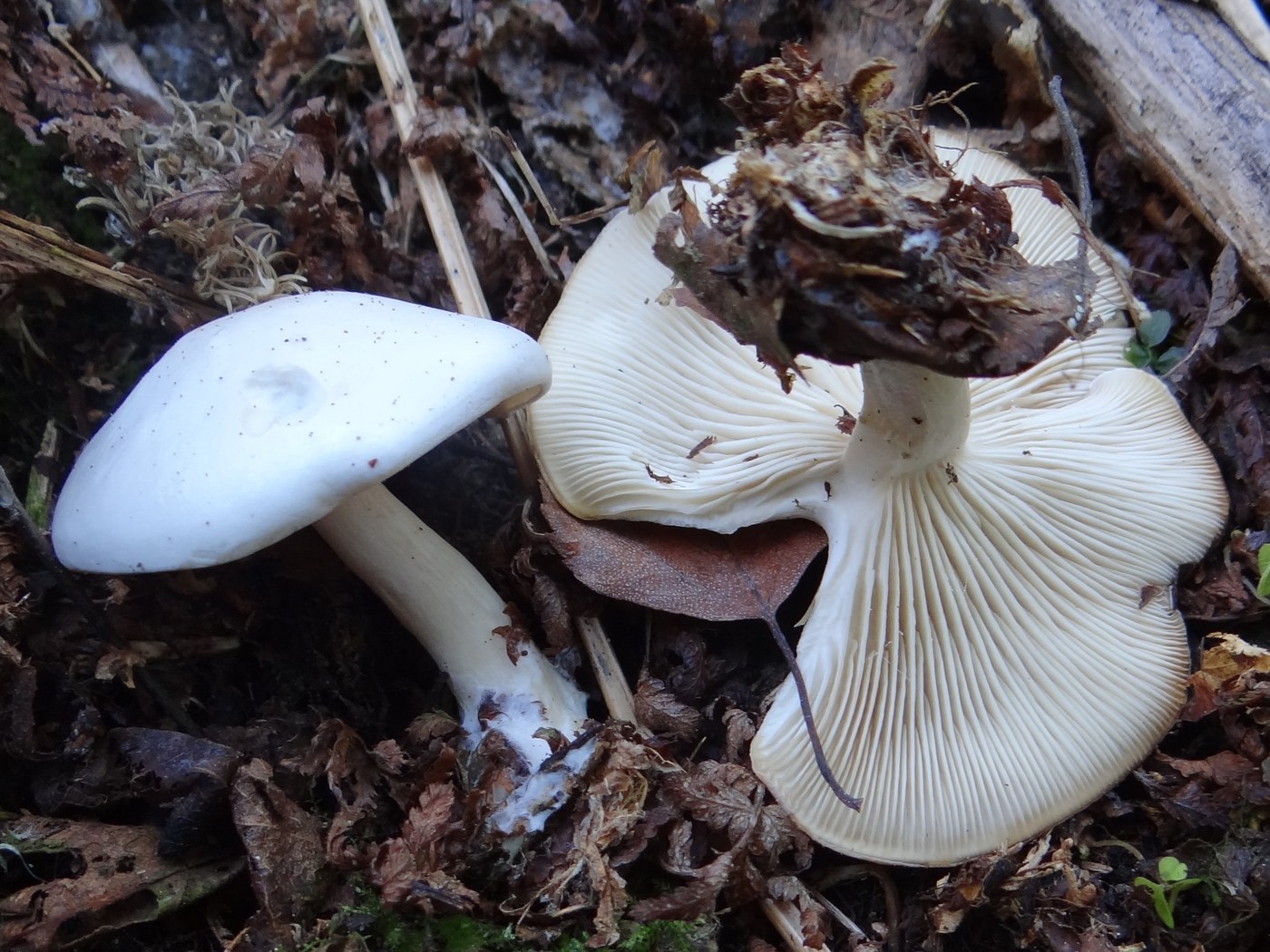
Frosty Funnel
Clitocybe phyllophila
Also called leaf-loving funnel, frosted funnel
A white woodland funnel whose cap carries a silky, frost-like bloom, growing in troops and arcs through deep autumn leaf litter.
- Group
- Gilled
- Cap
- Chalk-white cap with silky frosted bloom
- Spore print
- White to pale cream
- Habitat
- Deep leaf litter in broadleaf and mixed woodland
- Season
- Autumn to early winter
Overview
The Frosty Funnel is the largest of the white Clitocybe species commonly encountered in woodland, named for the fine silky bloom that lies over the cap surface like a dusting of hoar frost. Its scientific epithet, phyllophila, means leaf-loving and describes its habit of fruiting in the deepest accumulations of fallen leaves.
It sits within the core of the genus Clitocybe: a flattened to shallowly funnelled cap, crowded decurrent gills, a pale spore print, a ringless fibrous stipe and a mealy smell. Within that group, size, whiteness and the frosted surface set it apart from the smaller grassland funnels.
White funnels are notoriously difficult to separate from one another, and several names including C. cerussata and C. candicans attach to closely similar woodland species. The Frosty Funnel is generally the most robust of them, with a cap that can approach 10 cm and a stipe thick enough to feel substantial.
How to identify it
Cap
The cap is 4-10 cm across, convex with an inrolled margin at first, expanding to flat and then shallowly depressed, often with a wavy or irregularly lobed margin. The surface is dry and covered in a fine white pruinose or silky bloom, giving the frosted appearance; beneath the bloom the flesh colour is white to ivory, ageing to pale buff or developing faint pinkish-cream water marks and concentric zones.
Gills
The gills are crowded, narrow, thin and adnate to decurrent, running a short to moderate distance down the stipe. They are white at first and become dull cream, buff or faintly flesh-tinted with age. They peel readily from the cap flesh.
Stipe
The stipe is 3-8 cm long and 8-15 mm thick, cylindrical or slightly widened at the base, white to pale cream, finely fibrillose and often silky-shining. It becomes hollow in age and the base is bound in copious white mycelium and matted leaves. There is no ring and no volva.
Flesh and spore print
The flesh is white, moderately thin, and unchanging when cut, with a distinctly mealy or farinaceous smell. The spore print is white to very pale cream, occasionally with the faintest pinkish tinge, and the spores are smooth and elliptical.
Where and when it grows
The Frosty Funnel grows in deep leaf litter in broadleaf and mixed woodland, and also in conifer needle duff, hedge bottoms, shrubberies and well-mulched gardens. It thrives where the litter layer is thick and undisturbed, particularly under beech, oak, birch and pine.
Fruiting begins in autumn and continues into early winter. Fruit bodies commonly appear in troops, dense clusters or long arcs and rings, sometimes with several caps fused at the base. The species is widespread and frequent throughout Europe and is recorded across temperate North America and Asia.
Ecological role
This is a saprotrophic litter decomposer. Its mycelium colonises leaf and needle litter, breaking down cellulose and lignin and knitting the litter layer into a coherent white mat that can be lifted as a sheet where the fungus is active.
The mycelium expands radially, which produces the arcs and rings in which the fruit bodies appear, and it can dominate patches of woodland floor for years. Its late fruiting and tolerance of cool, wet conditions let it continue producing fruit bodies after many summer and early-autumn woodland agarics have finished.
Similar species
Clitocybe rivulosa, the Fool's Funnel, is much smaller and grows in short turf and lawns rather than woodland litter, with a more strongly zoned cap. Clitocybe candicans is smaller again, pure shining white with a thin, almost translucent cap and a slender stipe.
Clitopilus prunulus, the Miller, has a suede-textured, more strongly inrolled white cap and gills that turn salmon-pink at maturity, giving a pink spore print. Lepista species such as L. irina are white to pale buff with a stouter stipe, sinuate to slightly decurrent gills and a pale pink spore deposit. Where colour and shape agree, spore print colour on dark paper and habitat are the deciding characters.