
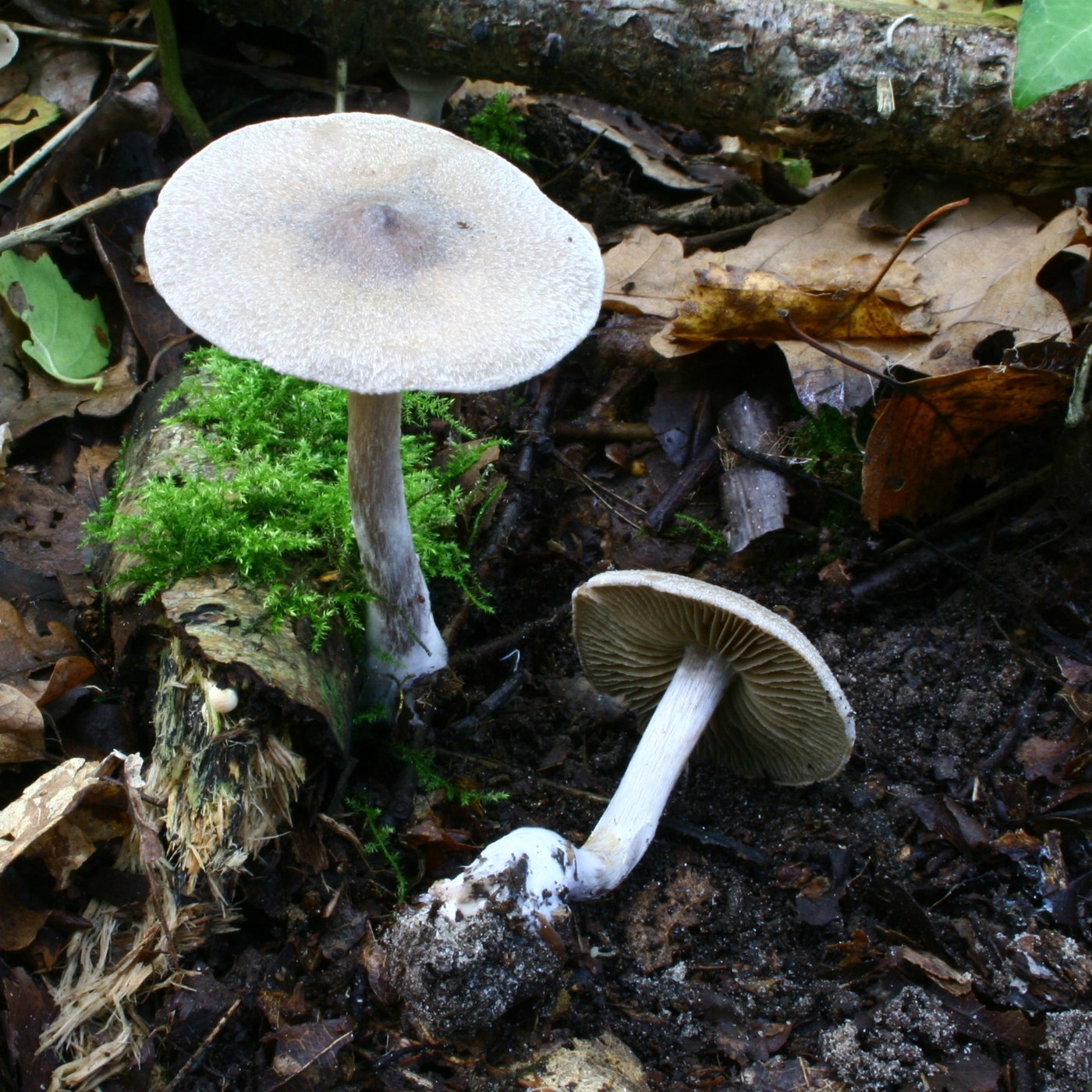
Frosty Webcap
Cortinarius hemitrichus
Also called white-flecked webcap
A small, slender birch webcap whose dark greyish-brown cap is dusted with fine white fibrils like hoar frost. The slim stem carries whitish veil girdles above a hygrophanous, umbonate cap.
- Group
- Gilled
- Cap
- Small dark brown cap frosted with white fibrils
- Spore print
- Rusty brown
- Habitat
- Damp birch woods, mossy ground
- Season
- Autumn
Overview
Frosty Webcap (Cortinarius hemitrichus) is a member of subgenus Telamonia, the group of small to medium webcaps with dry, hygrophanous caps that change colour dramatically as they lose moisture. It is one of the most frequently encountered small brown webcaps of birch woodland across the northern hemisphere.
Its common name comes from the covering of fine white fibrils and scurfy flecks that coats the young cap, producing a frosted or hoar-rimed appearance against a dark grey-brown ground. These fibrils are veil remnants and gradually wear away from the centre outwards, so mature specimens can be almost bare while young neighbours remain heavily frosted.
The genus Cortinarius is the largest of all agaric genera, with well over a thousand described species, and small Telamonia species like this one are notoriously difficult as a group. C. hemitrichus is one of the few that can be named with some confidence in the field, thanks to the combination of small size, birch association, frosted cap and slender girdled stem.
How to identify it
Cap
Small, typically 2–5 cm across, at first conical or bell-shaped and later expanding to a broadly convex shape with a persistent pointed umbo. The ground colour is dark greyish-brown to date-brown when moist, drying out to a much paler ochre-grey from the centre. The whole surface, and especially the outer half, is covered in fine white to silvery fibrils and small flecks that give the frosted effect.
Gills
Moderately spaced, adnate with a small notch, pale clay-brown or greyish-brown at first, ripening through cinnamon to a rich rusty brown. The gill edges are minutely fringed and slightly paler than the faces. In button stages a thin white cortina joins the cap edge to the stem.
Stipe
Slender and cylindrical, 4–9 cm tall but rarely more than 6–8 mm thick, often slightly wavy. It is greyish-brown and silky, decorated with one to several irregular whitish girdles or belts of veil tissue, which are the most useful confirming feature. The base may be slightly swollen and is bound to mossy litter by whitish mycelial threads.
Flesh & spore print
The flesh is thin, brownish and watery in the cap, paler in the stem, with a faint earthy smell. The mushroom is strongly hygrophanous, so colour depends heavily on how wet the specimen is. The spore print is rusty brown; the spores are ellipsoid and finely warted.
Where and when it grows
This species is essentially a birch specialist, appearing under Betula in damp woodland, on heaths with scattered birch, in birch carr and along boggy woodland edges. It favours acid, moist, mossy ground and often fruits in scattered troops among Sphagnum and other mosses or in short grass beneath the trees.
Fruiting runs through autumn, typically from late summer into the first frosts. It is common and widespread across northern and central Europe and occurs across boreal and northern temperate North America wherever birch is established.
Ecological role
Cortinarius hemitrichus is ectomycorrhizal with birch. Its hyphae envelop the tree's fine roots and extend into the surrounding soil as an absorptive network far finer than any root hair, capturing water and mineral nutrients from thin acid soils and passing them to the host in exchange for photosynthetic sugars.
Birch is a pioneer tree of poor, disturbed and boggy ground, and its mycorrhizal partners are a large part of what makes that colonisation possible. Small Telamonia webcaps such as this one are a numerically important component of that fungal community, and their fruitbodies in turn support a range of fungus-feeding insects and small mammals.
Similar species
Other small birch webcaps are the main confusion. Cortinarius flexipes (Pelargonium Webcap) is similarly frosted but has violaceous tints in young gills and stem and a strong pelargonium-leaf smell. Cortinarius paleaceus is very close in appearance, differing in its finer, more scaly veil flecks arranged over a darker cap.
Cortinarius armillatus is far larger and carries conspicuous brick-red veil bands on a swollen stem, while species of Galerina and Pholiotina growing in the same mossy ground are smaller still, have a smooth, non-frosted cap and often a distinct membranous ring rather than a cobwebby cortina. All webcaps here share a rusty brown spore print, so the frosted cap surface, slender girdled stem and birch association are the working characters.