
Hazel Bolete
Leccinellum pseudoscabrum
Also called hornbeam bolete, grey bolete, hazel scaber stalk
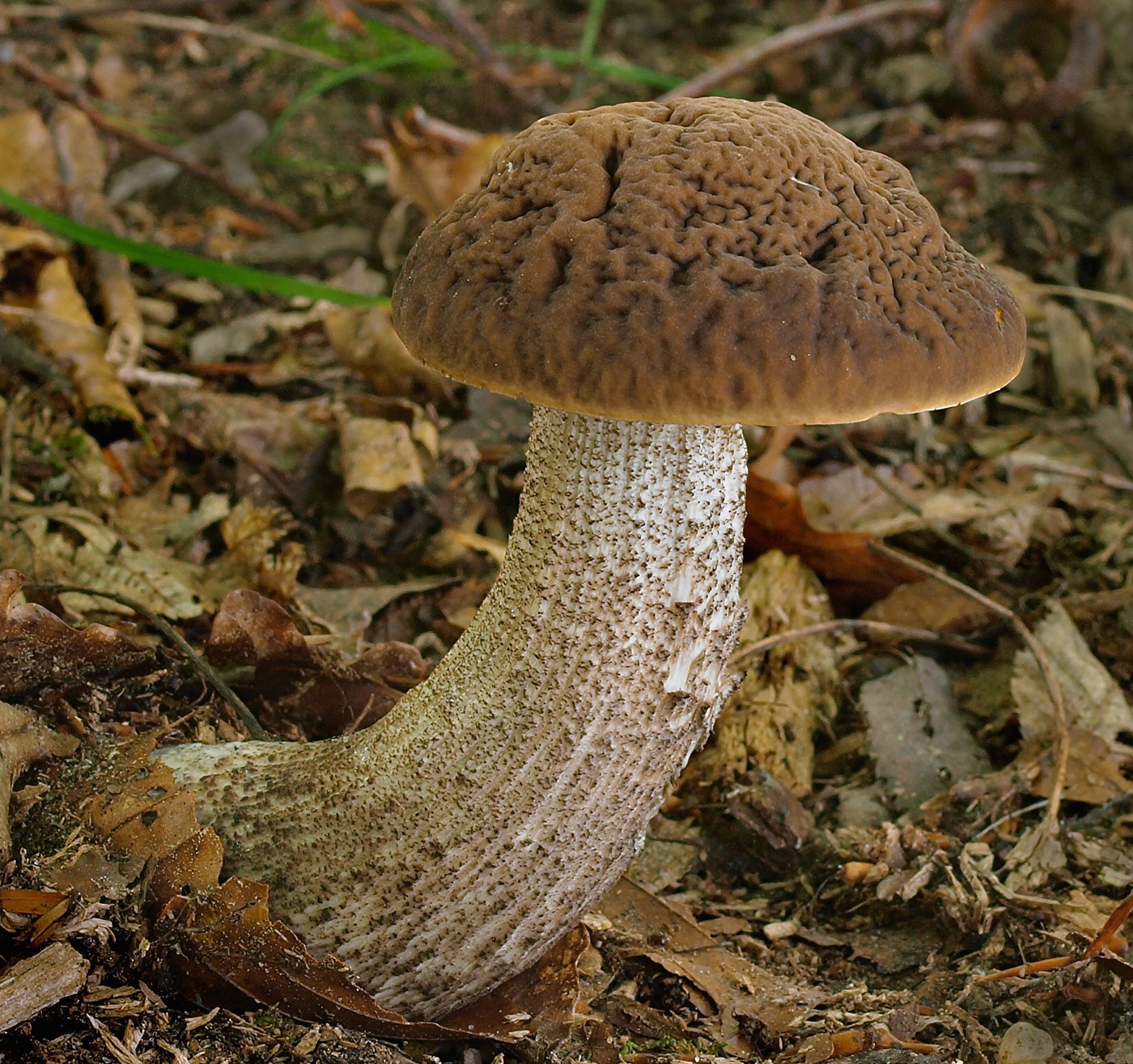
A scaber stalk of hazel and hornbeam with a distinctly wrinkled, pitted olive-brown cap and white flesh that darkens through pink to near black when cut.
- Group
- Boletes
- Cap
- Olive-brown to grey, wrinkled and pitted surface
- Spore print
- Ochre-brown
- Habitat
- Under hazel and hornbeam on richer soils
- Season
- Summer to autumn
Overview
The Hazel Bolete is the characteristic scaber stalk of hazel coppice and hornbeam woodland. It has passed under several names, including Leccinum pseudoscabrum and Leccinum griseum, and now generally sits in the segregate genus Leccinellum, which gathers a group of scaber stalks with yellowish tube tints or distinctive flesh reactions that molecular work separated from Leccinum proper.
Its most useful field character is cap texture. Rather than the smooth or evenly felted caps of most scaber stalks, this one is characteristically uneven, with shallow pits, wrinkles, and low ridges that give the surface a hammered or worked appearance, particularly as it expands. Colour is a dull olive-brown, grey-brown, or drab tan.
The second character is the dramatic darkening of the cut flesh, which passes through pink and grey to a deep charcoal or near black within a quarter of an hour. Combined with hazel or hornbeam overhead, the pitted cap and blackening flesh make this one of the more clear-cut species in an otherwise difficult group.
How to identify it
Cap
The cap is 4 to 12 cm across, convex and thick-fleshed. It is dull olive-brown, greyish-brown, or drab tan, and the surface is distinctively uneven, showing shallow pits, wrinkles, and low ridges rather than being smooth. It is dry and finely felted at first, becoming slightly greasy after rain.
Pores
Tubes are whitish to pale cream, becoming dingy buff or faintly yellowish-grey with age. Pores are small, round, and crowded, depressed around the stem, and they darken to brown or greyish where bruised.
Stipe
The stem is 5 to 12 cm tall and moderately stout, whitish to pale grey, and roughened with fine scabers that are pale grey to brown at first and blacken with age. It is more or less equal or slightly thickened downward, without a ring or volva.
Flesh and spore print
The flesh is white and firm. Cut surfaces turn pinkish to vinaceous within a minute or two, then progress through grey to a dark charcoal or nearly black, a reaction that is strong and quite fast in fresh specimens. The stem base does not turn blue-green. The spore print is ochre-brown.
Where and when it grows
This species grows with hazel above all, and also with hornbeam, and less often with beech, oak, or lime. It is a fungus of richer, often calcareous or neutral soils, in coppiced hazel, mixed broadleaf woodland, old hedgerows, scrubby woodland edges, and shaded lanes where hazel is abundant.
It is widespread through Europe and into western Asia, following the range of its host trees, and is generally more southerly and lowland in emphasis than the birch-associated scaber stalks. Fruiting runs from summer into autumn, with fruit bodies emerging singly or in small groups from leaf litter beneath the coppice canopy.
Ecological role
Leccinellum pseudoscabrum is ectomycorrhizal with hazel and hornbeam, forming a mantle over their fine roots and an exploratory hyphal network in the leaf litter and topsoil. Hazel coppice is a long-established managed habitat in much of Europe, and its associated fungal community, including this bolete, persists through repeated cutting cycles because the root systems and their fungal partners remain intact.
The fungus contributes to nutrient cycling by drawing nitrogen and phosphorus from decomposing leaf litter and transferring them to the trees. Its fruit bodies are seasonal and short-lived, providing a brief pulse of resource for invertebrates while dispersing spores from the tube layer. The species' preference for base-rich soils makes it a reasonable indicator of that soil type in mixed woodland.
Similar species
Leccinum scabrum is similar in colour but has a smooth, evenly domed cap without pits and wrinkles, flesh that barely changes when cut, and birch rather than hazel as its partner. Leccinum duriusculum also has dull colours and firm flesh but grows with poplar, roots deeply, and shows blue-green staining at the stem base which this species lacks.
Leccinellum crocipodium, another member of the same segregate genus, has a yellowish to olive-yellow cap that also cracks and wrinkles, yellow tubes, and grows chiefly with oak. Leccinum pseudoscabrum forms with markedly blackening flesh can also be confused with Leccinum melaneum, a smaller, darker birch species with a smooth cap. Cap texture and host tree are the two characters that settle it.