
Honey Mushroom
Armillaria mellea
Also called honey fungus, bootlace fungus, shoestring root rot
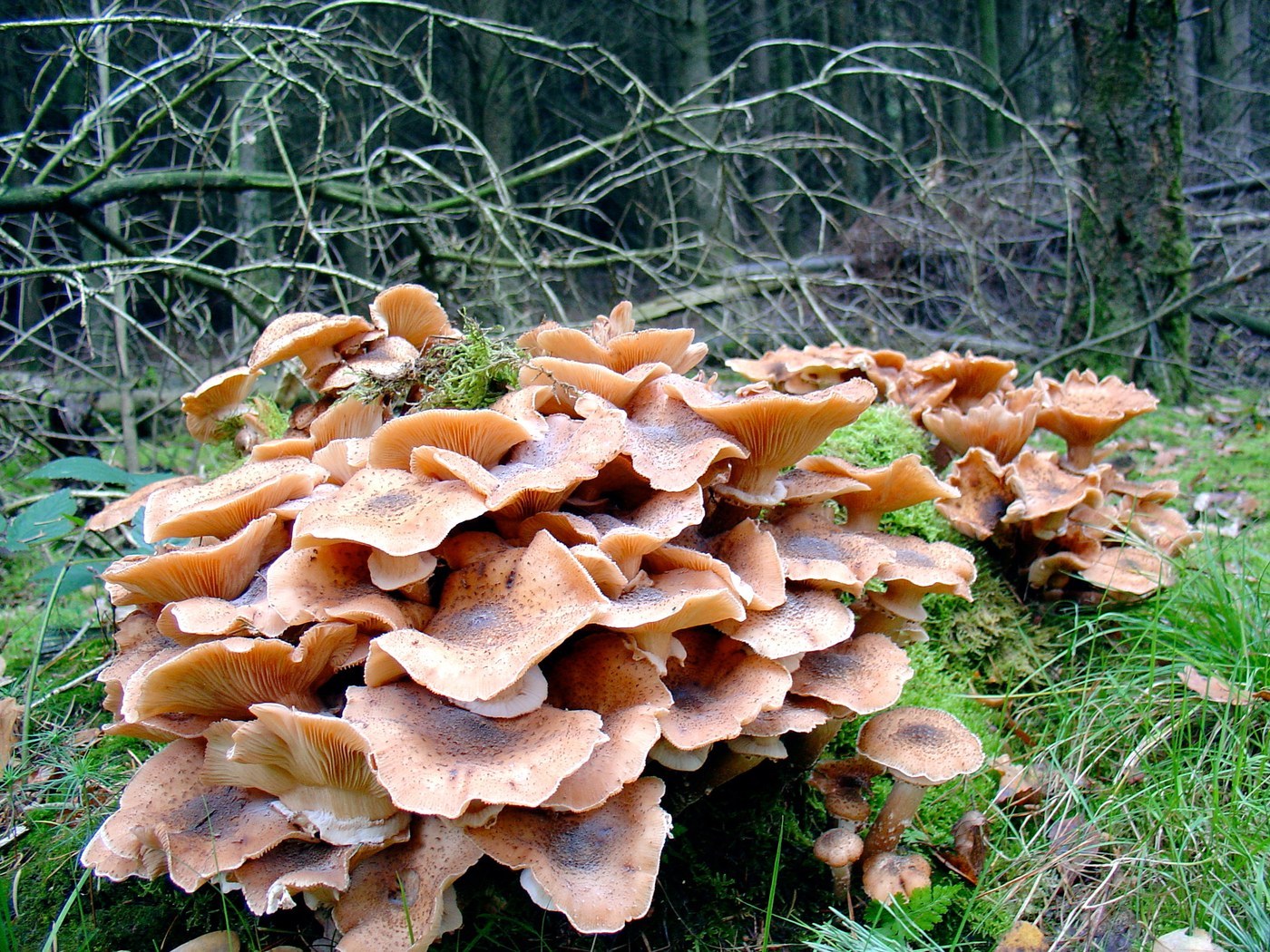
A clustered honey-coloured woodland fungus with a finely scaly cap, a thick woolly ring and black bootlace-like cords running under the bark of its host. It is one of the most important tree parasites in temperate forests.
- Group
- Gilled
- Cap
- Honey-yellow to tan, fine dark scales at centre
- Spore print
- White to pale cream
- Habitat
- Dense clusters at the base of hardwood trees
- Season
- Late summer to early winter
Overview
The Honey Mushroom is the best known member of Armillaria, a genus in the family Physalacriaceae that includes some of the most consequential wood-decaying fungi in the Northern Hemisphere. What was once treated as a single variable species is now recognised as a complex of biologically distinct species, with A. mellea in the strict sense joined in Europe and North America by A. ostoyae, A. gallica, A. borealis, A. cepistipes and others, separated by host preference, stem shape, ring structure and mating tests.
The genus is unusual among gilled fungi in producing rhizomorphs: tough, black, cord-like strands of bundled mycelium, resembling boot laces, that run beneath bark and through soil. These allow the fungus to bridge gaps between food sources and to attack new roots at a distance, and they are often more conspicuous than the mushrooms themselves. Peeling loose bark from an infected stump typically reveals a sheet of white mycelium and a network of black cords.
Armillaria is also famous for scale. Individual clonal networks of A. ostoyae mapped in Oregon and Michigan cover many square kilometres and are estimated to be thousands of years old, making them among the largest and oldest organisms known. The mycelium of several species is also bioluminescent, producing the faint green glow of decaying wood known as foxfire.
How to identify it
Cap
3-15 cm across, convex with an inrolled margin at first, expanding to flat and often slightly wavy or depressed with a low umbo. The colour is honey-yellow, tawny, ochre or olive-brown, usually darkest at the centre and paler toward the rim, and can be washed out in wet weather. The central area carries a scattering of fine, dark, erect fibrillose scales that thin out toward the margin; the rim is often faintly striate in age.
Gills
Adnate to slightly decurrent, running a short way down the stem, moderately spaced, whitish to pale cream at first and developing rusty, pinkish or brownish spotting and staining as they age. The gill faces of older clusters are frequently dusted white by spores falling from the caps above.
Stipe
5-15 cm tall and 0.5-2 cm thick, tough and fibrous, often curved where crowded in a cluster, and frequently tapering toward the base. It is whitish to yellowish above the ring and darkens through tan to dark brown toward the base. The ring is a key feature: thick, persistent, woolly to cottony, whitish with a yellowish fringed edge, sitting high on the stem.
Flesh & spore print
Flesh is white, firm in the cap and tough and stringy in the stem. The spore print is white to very pale cream. Black rhizomorphs, flattened white mycelial sheets under the bark of the host, and the tight caespitose clustering of dozens of fruiting bodies from a single point complete the picture.
Where and when it grows
The Honey Mushroom fruits in dense clusters at the base of living and dead broadleaved trees, on stumps, on exposed roots and on the ground above buried root systems. Oak, beech, ash, birch, willow, apple and many ornamental shrubs are frequent hosts, and it is a familiar presence in gardens, orchards, parks and hedgerows as well as in woodland. In the strict sense A. mellea is chiefly a hardwood species, while its relative A. ostoyae is the principal conifer specialist.
Fruiting is concentrated from late summer through to early winter, typically peaking in October and November in temperate Europe and continuing until hard frost. The species is widespread across Europe, temperate Asia and eastern North America, and members of the genus occur throughout the temperate Northern Hemisphere as well as in parts of Africa, South America and Australasia.
Ecological role
Uniquely among common woodland gilled fungi, this species is both an aggressive parasite and a capable saprotroph. Rhizomorphs grow out from an infected stump or root through the soil, contact the roots of a neighbouring tree, penetrate the bark and colonise the cambium. The fungus then forms white mycelial sheets between bark and wood, girdling the root collar and interrupting the flow of water and sugars, which produces the crown thinning, resin bleeding and sudden collapse familiar to gardeners and foresters.
Once the host is dead the fungus continues as a white-rot decomposer, breaking down both lignin and cellulose and leaving pale, soft, stringy residual wood. This dual role makes it a major agent of forest turnover: it creates canopy gaps by killing mature trees, then recycles the resulting deadwood. The rhizomorph network allows a single genetic individual to persist for centuries, moving through the soil from one food base to the next, which is why infections spread outward through orchards and gardens along root contacts and how the vast clonal patches of the genus arise.
Similar species
Armillaria gallica is the closest relative in gardens and woodland: it has a distinctly bulbous, club-shaped stem base, a thinner cobwebby yellow-edged ring, and it fruits in looser groups rather than tight tufts. Desarmillaria tabescens, the Ringless Honey Mushroom, matches the colour and clustering habit exactly but has no ring at all on its tapering stem. Pholiota squarrosa forms similar clusters on hardwood but is dry and covered all over cap and stem with coarse recurved shaggy scales, and it drops a rusty-brown spore print.
Hypholoma fasciculare clusters on stumps too but is smaller, brighter sulphur-yellow, has greenish-yellow gills, no ring, and prints purple-brown. Galerina marginata grows in smaller groups on decaying conifer wood, is smooth and hygrophanous rather than scaly, has a thin membranous ring and prints rusty brown. A white spore print, a thick woolly ring, fine dark scales on a honey-coloured cap and black rhizomorphs under the bark together confirm Armillaria.