
Lake's Bolete
Suillus lakei
Also called western painted suillus, matte jack
A scaly reddish-brown bolete of Douglas-fir woods with large radial yellow pores and a ring zone. Flesh at the very stalk base often flushes blue-green.
- Group
- Boletes
- Cap
- Dry cap with reddish-brown fibrous scales
- Spore print
- Olive-brown to cinnamon
- Habitat
- Under Douglas-fir
- Season
- Autumn, sometimes spring
Overview
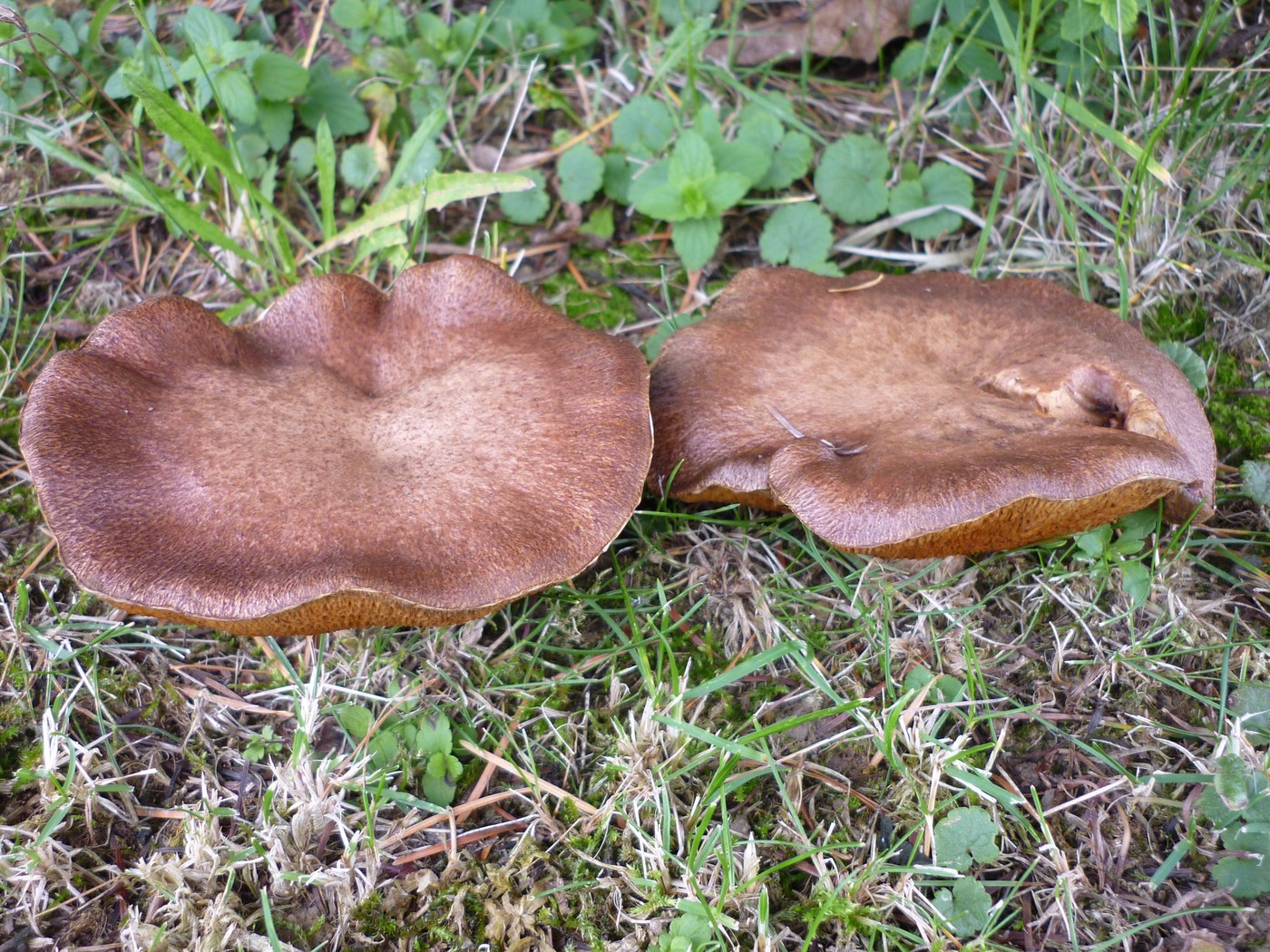
Lake's Bolete is the Douglas-fir specialist of the dry-capped Suillus group, filling in western North America the niche that the Painted Suillus occupies with white pine in the east. Its cap is dry and matted with reddish-brown to brick fibrils that break into scales over a yellow ground, and a cottony veil leaves a ragged zone on the stalk.
Among western boletes it is one of the easiest to name to genus, thanks to the combination of large radially arranged pores, soft flesh, olive-brown spores and a veil. Confirming the species usually depends on the host, since Douglas-fir association is close to absolute, and on the blue-green tint that often develops in the flesh at the extreme base of the stalk.
Because Douglas-fir has been planted widely for timber, the fungus now turns up far from its native range, including in European and southern hemisphere plantations, where it is one of the few American ectomycorrhizal fungi to have established successfully.
How to identify it
Cap
5-15 cm across, convex then flattened, dry to slightly tacky in wet weather, covered with appressed fibrillose scales in reddish-brown, brick or rusty tones over a yellow to ochre ground. Weathered caps fade to dull tan with the yellow ground more exposed. Veil remnants often fringe the margin.
Pores
Large, angular and radially arranged, running slightly down the stalk. Bright yellow when young, dulling to ochre and bruising brownish to dingy reddish-brown where handled.
Stipe
4-10 cm tall and 1-2.5 cm thick, yellow at the apex above the veil line and covered below with reddish-brown fibrillose patches. A soft cottony ring zone is usually present and becomes brown-stained. The base is solid.
Flesh & spore print
The flesh is yellow, slowly turning pinkish to reddish-brown when cut, and the tissue in the extreme stalk base often flushes a distinct blue-green. The spore print is olive-brown to cinnamon.
Where and when it grows
Ectomycorrhizal with Douglas-fir (Pseudotsuga menziesii), and effectively confined to woodland and plantations containing that tree. It fruits on soil, needle duff and mossy ground under mature and young Douglas-fir, along trails and forest edges, singly or in scattered troops.
The main season is autumn, with additional spring fruitings in parts of the Pacific Northwest and California. It is common throughout western North America and has been carried with planted Douglas-fir into Europe, South America, Australia and New Zealand.
Ecological role
The species forms ectomycorrhizal root tips on Douglas-fir, sheathing fine roots in a fungal mantle and sending exploratory hyphae into the surrounding soil to acquire phosphorus, nitrogen and water in exchange for host carbon. Its host fidelity is among the strictest in the genus.
That specificity has made it a travelling companion of Douglas-fir forestry: nursery soil carrying its mycelium has introduced it to plantations on several continents, where it may be one of very few compatible mycorrhizal partners available to the exotic tree. In its native range it is a common component of the ectomycorrhizal community of young and mid-aged Douglas-fir stands.
Similar species
Suillus caerulescens is the closest match, sharing the Douglas-fir host and a scaly cap, but its cap is usually paler yellow-brown with less distinctly red fibrils and it is often somewhat slimier; the blue-green stalk base staining tends to be stronger and more consistent. Suillus ponderosus has a glutinous, sticky scaly cap rather than a dry felted one.
Suillus spraguei is very similar in appearance but grows only with five-needle white pine in eastern North America and lacks blue-green base staining. Suillus cavipes also has a dry scaly cap and radial pores but partners larch and has a hollow, chambered stalk base.