
Panther Cap
Amanita pantherina
Also called panthercap, false blusher
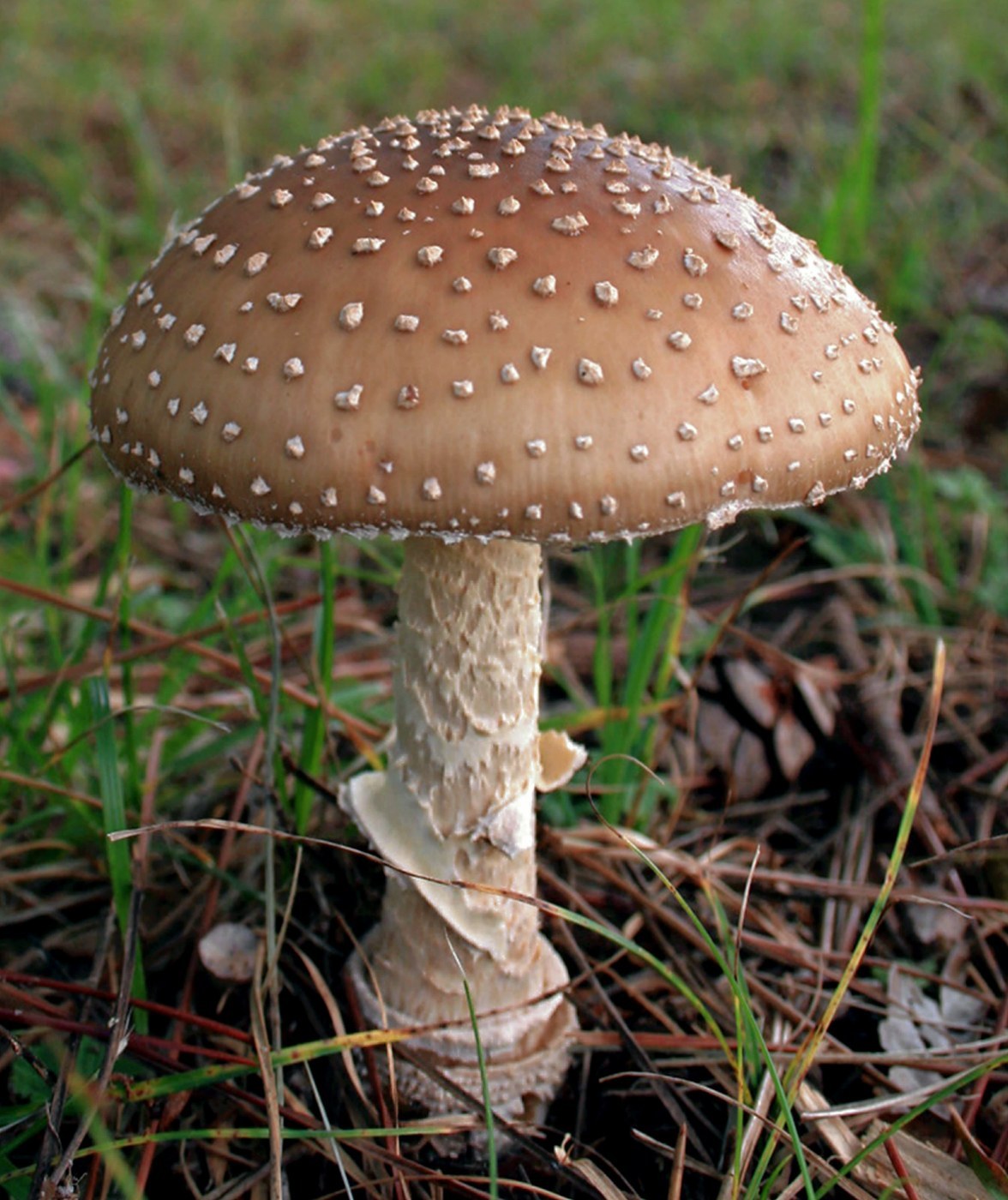
A brown-capped Amanita speckled with small pure-white warts, with a strongly grooved cap margin, white unchanging flesh, and a stem base finished with an abrupt collar-like rim.
- Group
- Gilled
- Cap
- Brown cap with pure white warts, grooved margin
- Spore print
- White
- Habitat
- Beech, oak and conifer woodland
- Season
- Summer to autumn
Overview
Amanita pantherina belongs to Amanita section Amanita, the group that also contains Fly Agaric and Amanita gemmata. Members of this section share a warty cap derived from a friable universal veil, a strongly grooved cap margin in most species, non-amyloid spores, and a stem base that ends in a bulb bearing a distinct rim or collar rather than a loose membranous bag.
The Panther Cap is a mid-sized woodland Amanita whose colouring, warm brown scattered with small crisp white dots, gives it its common name. In good condition it is one of the more elegant brown Amanitas, with the white flecking arranged in loose concentric rings and a neatly furrowed cap edge. Faded or rain-washed specimens are much duller and are frequently confused with other brown Amanitas.
Modern authors regard the species as a complex, with several regionally distinct taxa in North America and Asia that were long lumped under the European name. Amanita multisquamosa and Amanita velatipes in eastern North America and various pale Asian forms sit close to it, and the group as a whole is still being resolved.
How to identify it
Cap
5-12 cm across, hemispherical at first, expanding to convex then broadly flat. The surface is warm mid-brown, olive-brown, greyish-brown or hazel, usually darker at the centre, and evenly scattered with numerous small, crisp, pure-white pyramidal warts arranged in rough concentric rings. The margin is distinctly and conspicuously grooved or striate for several millimetres, a feature that stands out even in older specimens. The surface is slightly sticky when moist.
Gills
Free from the stem, crowded, moderately broad, pure white and remaining white, with minutely fringed edges. Short gills of varying lengths run between the full-length ones.
Stipe
6-13 cm tall and 1-2 cm thick, white, dry, smooth to slightly fibrillose. The ring is white, membranous, hangs from the middle or lower part of the stem and is smooth on its upper surface rather than grooved. The stem base swells into an abrupt, more or less spherical or turnip-shaped bulb that is finished at the top with a sharp, free, collar-like rim, and often carries one or two narrow ring-like girdles just above it. This collared bulb is the single most reliable structural feature of the species.
Flesh & spore print
Flesh white and unchanging when cut or bruised, with no pink, red or brown discolouration developing. Smell faint. The spore print is white and the spores are ellipsoid and non-amyloid, in contrast to the amyloid spores of section Phalloideae.
Where and when it grows
The Panther Cap is ectomycorrhizal and grows on soil in broadleaf and mixed woodland, most often with beech and oak, and also with birch, hornbeam, pine and spruce. It shows some preference for calcareous and well-drained soils but is not restricted to them, and appears in mature woodland, on wooded banks and along shaded paths, generally singly or in small scattered groups.
Fruiting runs from midsummer to late autumn. The species is widespread across Europe and temperate Asia, with closely related taxa in North America occupying similar niches under oak, pine and Douglas fir. Records from other continents often refer to segregate species rather than to European A. pantherina in the strict sense.
Ecological role
This fungus builds ectomycorrhizas with its host trees, forming a sheath of hyphae over the fine root tips and a Hartig net between the cortical cells. Nitrogen, phosphorus and water are delivered to the tree, and in exchange the fungus receives sugars it cannot manufacture itself. The extensive mycelial network also links neighbouring root systems and contributes to soil structure by binding particles with hyphae.
Because the association is obligate, Panther Cap fruiting reflects the health and age of the surrounding stand: it is far more frequent in mature woodland with established root systems than in young plantations. The short-lived fruiting bodies are colonised by fungus gnats and beetles and break down within days, cycling nutrients back into the humus.
Similar species
The Blusher (Amanita rubescens) is the closest match in size and general appearance but differs in several structural ways: its warts are dirty grey-pink rather than pure white, the cap margin is smooth or only faintly grooved, the ring is grooved on its upper surface, the stem base is swollen but has no collar-like rim, and all parts slowly stain pinkish-red where damaged. Amanita excelsa (Amanita spissa) has grey-brown, mealy veil patches, a grooved ring, an ungrooved cap margin and a tapering rooting base without a sharp collar, and its flesh does not redden.
Amanita gemmata is paler, straw to buff-yellow, with fewer white veil patches, a fragile ring and a similar rimmed bulb, and intermediates between the two are frequently found. Brown American forms of Fly Agaric (Amanita muscaria) can approach the Panther Cap in colour but have several shaggy concentric girdles on a club-shaped base rather than a single sharp collar.