Pleated Inkcap
Parasola plicatilis
Also called little japanese umbrella, japanese parasol
A tiny, exquisitely pleated grey mushroom that opens like a paper parasol on lawns after rain and collapses by the afternoon. Its gills attach to a collar rather than the stipe.
Overview
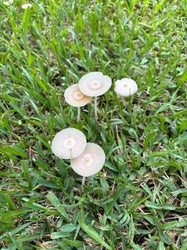
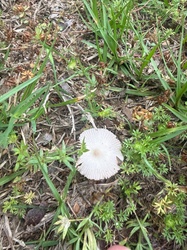
The Pleated Inkcap, Parasola plicatilis, is one of the most delicate agarics found in ordinary lawns. Its cap is at most a few centimetres across, sculpted into deep radiating grooves that run from a small sunken tan disc out to a papery grey margin, so that from above it looks exactly like a miniature folded parasol — the source of its alternative name, the Little Japanese Umbrella.
The genus Parasola was separated from Coprinus for a group of small, ephemeral, deeply pleated species whose gills do not truly dissolve into ink. Instead they simply shrivel, blacken, and collapse as the cap dries, a difference in strategy that, along with distinctive spore shapes and the absence of a true veil, justified giving them their own genus.
Because it appears overnight after rain and is gone by early afternoon, it is far commoner than casual observation suggests. Anyone who walks a damp lawn at breakfast in summer will meet it; anyone who looks at the same lawn after lunch will find nothing at all.
How to identify it
Cap
Very small, 1–3 cm across when expanded. It begins as a tiny ellipsoid or narrowly egg-shaped button, pale grey-brown, then opens rapidly to a flat or shallowly upturned disc. The surface is bald — with no woolly or granular veil at any stage — and deeply and regularly grooved along radiating lines that follow the gills beneath. A small central disc stays dull tan, date-brown, or ochre while the rest of the cap is pale grey to greyish-brown.
Gills
Grey turning black, thin and rather distant. Their key feature is that they do not reach the stipe: instead they are attached to a narrow free collar encircling the top of the stem, so the gills appear to hang from a ring rather than run onto the stipe. They blacken and shrivel as the cap collapses rather than dripping ink.
Stipe
Extremely slender and fragile, 4–8 cm tall but often less than 2 mm thick, hollow, straight, white to very pale grey, smooth and slightly shining, with no ring and only a faintly swollen base. It bends easily and snaps at a touch.
Flesh and spore print
The flesh is almost nonexistent — the cap is little more than a membrane — and is odourless. The spore print is black, and under the microscope the spores are large, smooth, and characteristically shaped, a feature used to separate the several near-identical Parasola species.
Where and when it grows
A grassland species of short, well-trodden turf. It is most familiar on lawns, playing fields, park grass, grassy paths, roadside verges, and cemetery turf, and also occurs among mosses and in bare grassy patches at woodland edges. It prefers damp, fairly rich soil and tolerates regular mowing well.
Fruiting runs from late spring through summer to autumn, always triggered by rain: fruit bodies push up overnight in warm wet conditions, open at first light, and collapse by midday or early afternoon. It is cosmopolitan, common throughout Europe, North America, and temperate regions worldwide, and often appears in troops of dozens scattered across a single lawn.
Ecological role
Parasola plicatilis is a saprotroph living on dead grass roots, thatch, and fine organic debris in the top layer of turf soil. It is a rapid-turnover recycler: the mycelium is fine and diffuse, exploits small, quickly exhausted pockets of dead plant material, and converts moisture and a brief warm spell into an equally brief burst of spore production.
The pleated cap is an elegant solution to being both very thin and mechanically stable. The radiating folds act as ribs, letting a membrane a fraction of a millimetre thick hold itself open like a fan while spores are shed from the deep, widely spaced gills, after which the whole structure simply dries and falls. Unlike the larger inkcaps this species barely deliquesces, relying instead on being open just long enough during the humid early morning hours for spores to be released and carried off.
Similar species
Parasola leiocephala and Parasola auricoma are near-identical in form; P. auricoma can be told by the tiny stiff dark hairs on the cap surface visible with a hand lens, while P. leiocephala has a more conical young cap and differs mainly in spore shape. All three share the bald, deeply pleated cap and the collar to which the gills attach.
The Fairy Inkcap (Coprinellus disseminatus) grows in huge swarming troops on and around rotting stumps rather than in open lawn, has a finely granular rather than bald cap surface, and its gills attach directly to the stipe with no collar. Coprinopsis lagopus is much larger and is covered in white wool when young, a veil that Parasola never has.
Common questions about Pleated Inkcap
What does the pleating on the cap do?
How are the gills attached?
Why is it so rarely noticed?
Does it really turn to ink?
Pleated Inkcap found by the community
Photos submitted through the app and matched to this entry.