
The Prince
Agaricus augustus
Also called giant agaricus, almond mushroom
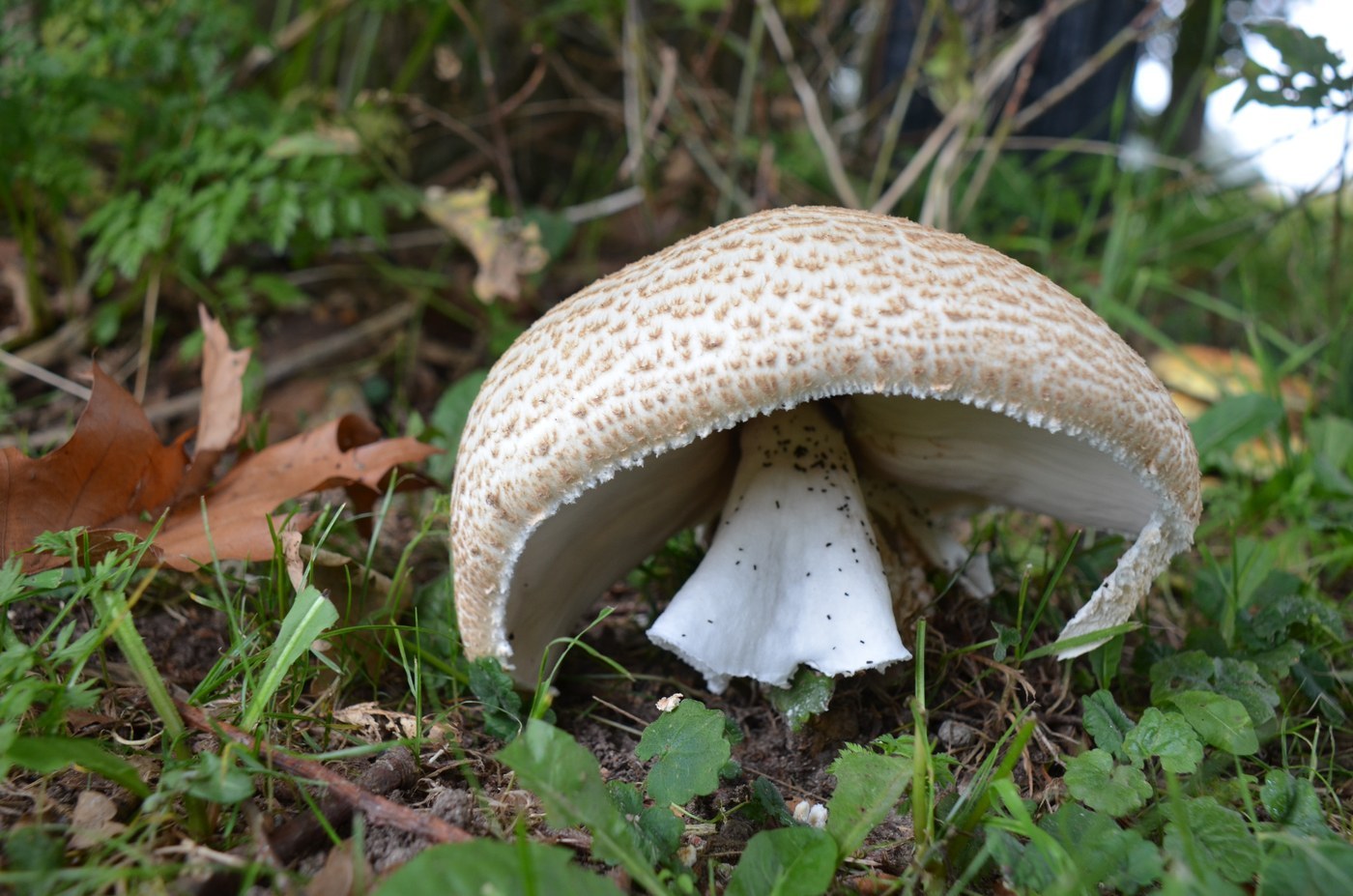
One of the largest field mushrooms, with a squarish young cap patterned in fine golden-brown fibrous scales, a big pendulous ring and flesh that yellows slowly where handled. It smells strongly of almonds.
- Group
- Gilled
- Cap
- Large, with tawny-brown fibrous scales on cream
- Spore print
- Dark brown
- Habitat
- Rich soil under conifers, hedges, path edges
- Season
- Summer to autumn
Overview
The Prince is the giant of the Agaricus genus in Europe and North America, with caps that regularly reach 20 cm and occasionally 40 cm. Agaricus belongs to the family Agaricaceae and is defined by free gills that pass from pale through pink to dark chocolate-brown, a dark brown spore print, and a partial veil that leaves a ring on the stem. It is a large and taxonomically busy genus, divided into sections by staining reaction, odour and scaling.
Within that framework A. augustus sits in the section of yellowing, almond-scented species alongside A. arvensis and A. subrufescens. These share a slow chrome or straw-yellow discolouration of the surface and flesh when rubbed or cut, and a distinctive sweet aroma of bitter almonds or aniseed. The scaling pattern separates A. augustus from the rest: the cap is not white but broken into fine, flat, tawny to golden-brown fibrillose scales over a pale ground, arranged in loose concentric rows.
The young fruiting body is unusually shaped, almost box-like or squared off, with a flat top and near-vertical sides, before it expands into a broad convex disc. Combined with its size, its handsome patterning and its almond scent, this makes it one of the most recognisable large gilled fungi of gardens, hedgerows and conifer plantings.
How to identify it
Cap
10-25 cm across and sometimes far larger, at first a squarish or barrel-shaped block with a flattened top and abruptly angled sides, then expanding through broadly convex to almost flat. The surface is covered in numerous fine, flat, tawny, golden-brown to coppery fibrillose scales arranged in loose concentric bands over a whitish to cream ground, densest at the centre. Rubbing the surface produces a slow yellow flush.
Gills
Free from the stem and crowded, narrow, pale greyish-white when very young and covered by the veil, then turning through greyish-pink and dull pink to a deep chocolate-brown at maturity. The colour change is progressive and reliable, and mature gills darken the whole underside of the cap.
Stipe
10-20 cm tall and 2-4 cm thick, stout, white, often slightly swollen toward the base, and covered below the ring with soft woolly or floccose white to yellowish scales. Above the ring it is smoother and finely floury. The ring is large, thick, pendulous and double-edged, hanging like a skirt with a soft ragged underside, and often flushing yellow where touched.
Flesh & spore print
Flesh is thick, firm and white, staining slowly yellowish where cut or bruised, particularly in the stem base and cap surface, and sometimes ageing to a dull ochre. The odour is strong and sweet, of bitter almonds or aniseed. The spore print is dark chocolate-brown.
Where and when it grows
This species favours rich, well-drained, humus-laden soils in partly shaded settings. It fruits along the edges of paths and drives, under hedges, in shrubberies, in gardens, in churchyards and parks, and very characteristically under and around conifers, especially planted cypress, cedar, spruce and pine in gardens and amenity planting. It also occurs in deciduous woodland edges and on disturbed roadside banks.
Fruiting runs from midsummer through to late autumn, generally peaking in late summer and early autumn following rain. Fruiting bodies often appear singly or in small groups, sometimes in arcs, and the same site can produce crops for many years. The species is widespread throughout Europe, common in western and central North America including the Pacific Northwest and California, and has been introduced with amenity planting to parts of Australasia and southern Africa.
Ecological role
Agaricus augustus is a saprotroph of rich soil and humus. Its mycelium spreads through the organic-rich upper soil, decomposing leaf litter, fine woody debris, root fragments and other accumulated plant material, and releasing the nutrients they contain into the soil solution. It forms no mycorrhizal partnership, so its association with conifers reflects the deep, undisturbed, needle-enriched litter that builds up under them rather than any exchange with the tree.
Because it depends on accumulated organic matter, it responds well to sheltered and undisturbed ground, and long-established garden hedge bottoms, mature shrubberies and old plantings are its most reliable sites. Its very large fruiting bodies represent a substantial investment of resources and correspondingly release enormous quantities of dark spores, which are shed over several days as the broad gill surface matures. Fallen caps in turn support communities of fungus-feeding flies, beetles and mites.
Similar species
Agaricus arvensis, the Horse Mushroom, shares the almond odour and yellowing reaction but has a smooth creamy-white cap with no brown fibrillose scaling, and a ring whose underside bears a distinctive cogwheel pattern of radiating soft flaps. Agaricus subrufescens is similar in scaling and scent but is smaller, more slender, and its scales are duller pinkish-brown. Agaricus urinascens is comparably huge but has a smooth, dull whitish, cracking cap rather than a tawny scaly one.
Agaricus xanthodermus can grow nearby and also yellows, but its yellowing is instant and vivid chrome, most dramatically in a cut stem base, its cap is smooth and greyish-white rather than tawny-scaled, and its odour is sharply phenolic rather than sweetly of almonds. Macrolepiota procera, the parasol, is comparable in size but has white gills that stay white, a white spore print, a movable double ring, and a stem patterned in dark snakeskin banding.