False Parasol
Chlorophyllum molybdites
Type: gilled mushroom
Physical Characteristics
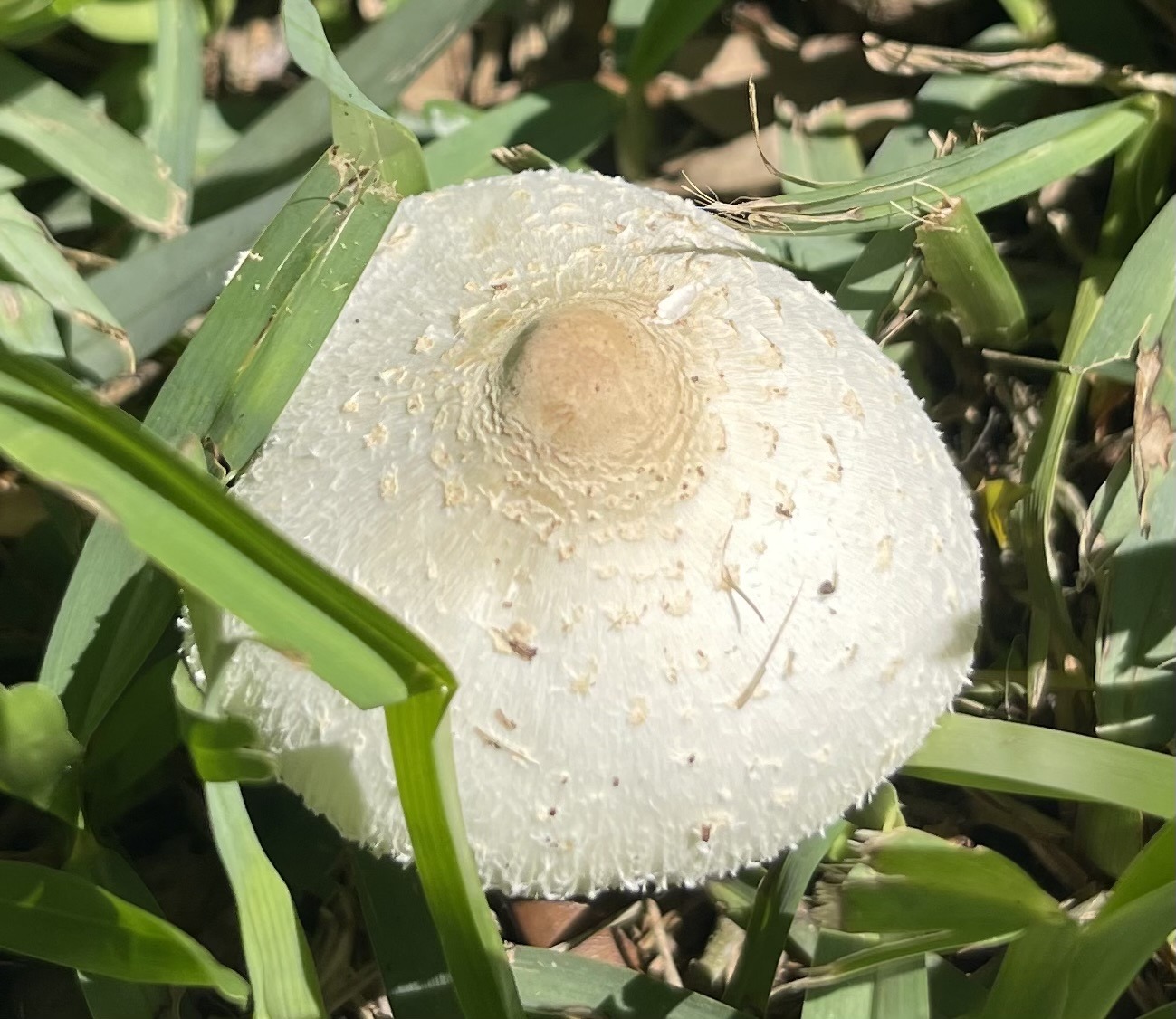
Large white cap with brownish scales; greenish gills when mature; a prominent double-edged ring on the stem.
Habitat & Growing Conditions
Commonly grows in grassy areas like lawns, parks, and golf courses; often forms fairy rings.
Season & Fruiting Time
Summer and autumn, especially after heavy rains in warm climates.
Similar Looking Species
Chlorophyllum rhacodes (Shaggy Parasol) which has a white spore print, and Macrolepiota procera (Parasol Mushroom) which also has a white spore print and a snakeskin-like pattern on the stem.
Ecological Role
Saprophytic, breaking down organic matter in the soil and grass thatch.
Fruiting Body
Cap starts ball-shaped and expands to a broad convex or flat shape with a brownish central bump (umbo); surface is white with scattered brownish scales. Hymenophore consists of free, crowded gills that turn from white to a distinctive dingy green as spores mature. The stipe is long, smooth, and features a thick, movable ring.
Size
Cap diameter 5-40 cm; stipe height 5-25 cm and 1-4 cm thick.
Spore Print
Green to olive-green
Distribution
Widespread in tropical and subtropical regions, becoming increasingly common in temperate areas of North America.
Identification Tips
The most diagnostic feature is the green spore print in mature specimens. Check for free gills that have a greenish tint and the presence of a double-edged ring on its smooth stem.
Interesting Facts
This species is famous for forming large 'fairy rings' in suburban lawns. It is one of the most frequently encountered mushrooms in urban landscapes during the summer months.
Safety reminder
AI mushroom identification is a best-effort estimate and can be wrong. Never use it to decide whether a mushroom is safe to handle or eat — always confirm with a qualified mycologist before any consumption.
Identified on: 5/16/2026
Mode: Standard