Lilac Bonnet, Amethyst Deceiver
Mycena pura, Laccaria amethystina
Type: gilled mushroom
Physical Characteristics
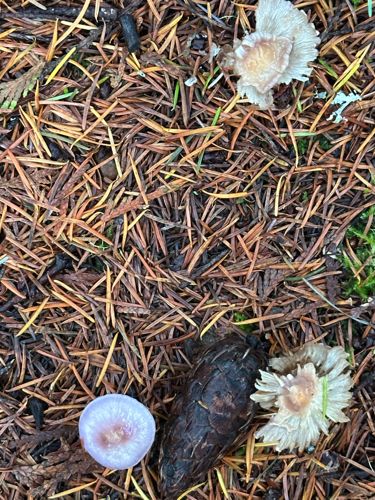
The image appears to show two distinct types of mushrooms. The small purple/lilac mushroom with a rounded cap (bottom left) is characteristic of a 'Laccaria amethystina' (Amethyst Deceiver), known for its vibrant purple color, particularly when young and fresh, and a cap that can be convex to flat, often with a somewhat depressed center. It has widely spaced gills of the same color as the cap. The other mushrooms (top right and bottom right) have a more delicate, somewhat translucent, and pleated appearance, possibly indicating a species from the 'Mycena' genus, such as 'Mycena pura' (Lilac Bonnet). These typically have a bell-shaped to conical cap, often with striations, and can range in color from white to various shades of pink or lilac, though the ones in the image appear paler.
Habitat & Growing Conditions
Both species are typically found in woodlands. The Amethyst Deceiver ('Laccaria amethystina') is a mycorrhizal fungus, forming symbiotic relationships with many tree species, especially conifers and deciduous trees. It grows on soil, often among leaf litter or moss. The Lilac Bonnet ('Mycena pura') is a saprobic fungus, growing on decaying wood debris (like needles and twigs) or rich humus in coniferous and deciduous forests.
Season & Fruiting Time
Both species are generally found from late summer through autumn, and sometimes into early winter in milder climates. Their appearance is often triggered by cool, moist conditions following rainfall.
Similar Looking Species
For 'Laccaria amethystina': 'Laccaria laccata' (Deceiver) is similar but typically brown to orange-brown. Some 'Cortinarius' species can be violet but usually have a cortina (cobweb-like veil) when young and rusty brown spore prints. For 'Mycena pura': There are many 'Mycena' species, some of which are very similar in shape and size but differ in color or subtle cap/gill features. 'Mycena rosea' is similar but typically larger and more distinctly pink. Distinguishing between 'Mycena' species often requires microscopic examination.
Ecological Role
The Amethyst Deceiver ('Laccaria amethystina') plays an important role as a mycorrhizal symbiont, exchanging nutrients with tree roots, enhancing the tree's uptake of water and minerals, and contributing to forest health. The Lilac Bonnet ('Mycena pura') is a saprobic fungus, meaning it obtains nutrients by decomposing organic matter, primarily leaf litter and woody debris. This process of decomposition is vital for nutrient cycling in the forest ecosystem, breaking down complex organic material into simpler compounds that can be reused by plants and other organisms.
Safety reminder
AI mushroom identification is a best-effort estimate and can be wrong. Never use it to decide whether a mushroom is safe to handle or eat — always confirm with a qualified mycologist before any consumption.
Identified on: 11/21/2025
Mode: Standard