Red-banded Polypore
Fomitopsis pinicola
Type: Polypore
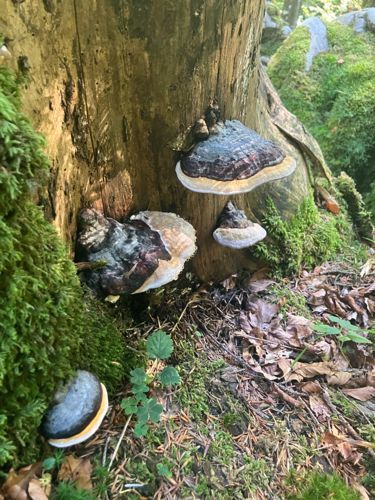
Physical Characteristics
Caps are hoof-shaped or shelf-like, typically 5-30 cm wide, and thick. The upper surface is zoned with concentric bands of color, often starting with a reddish-brown or orange near the margin, fading to grey, black, or brown towards the attachment point. The margin is usually rounded and typically whitish or yellowish when growing. The pore surface is poroid, white to cream-colored, becoming yellowish or brownish with age or when bruised. Pores are small (3-4 per mm). The flesh is tough, corky to woody, and pale cream to brownish.
Habitat & Growing Conditions
This fungus is saprobic and parasitic, growing on dead or living coniferous and deciduous trees, especially favoring spruce, fir, pine, and birch. It causes a brown rot in wood.
Season & Fruiting Time
Perennial; fruit bodies can be found year-round, as they are tough and persist for several years, adding new growth each season.
Similar Looking Species
Similar looking species include Ganoderma applanatum (Artist's Conk), which has a darker, more uniform cap and a white pore surface that bruises brown easily, allowing for 'drawing'. Other Fomitopsis species or similar bracket fungi may be mistaken but typically lack the distinctive red band near the margin.
Ecological Role
Fomitopsis pinicola acts as both a saprophyte, decomposing dead wood and recycling nutrients back into the ecosystem, and a parasite, causing brown rot in living trees. It plays a significant role in forest ecosystems by breaking down woody debris.
Safety reminder
AI mushroom identification is a best-effort estimate and can be wrong. Never use it to decide whether a mushroom is safe to handle or eat — always confirm with a qualified mycologist before any consumption.
Identified on: 9/20/2025
Mode: Standard