Shaggy Parasol
Chlorophyllum rhacodes
Type: gilled mushroom
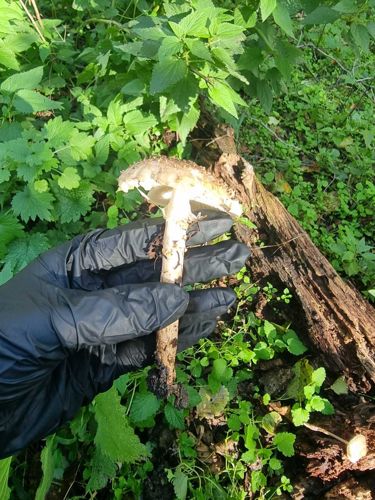
Physical Characteristics
The cap of the Shaggy Parasol is typically 5-15 cm in diameter, initially egg-shaped, expanding to convex and then flat, with a prominent central umbo. It is whitish to brownish, covered with shaggy, brownish scales that easily rub off, revealing a lighter background. The gills are free from the stem, crowded, and white, becoming dull pinkish or brownish with age. When bruised, the gills often stain reddish to brownish. The stem is 8-20 cm long and 1-2.5 cm thick, cylindrical, tapering slightly upwards, with a cottony, detachable ring. The stem surface is often smooth and whitish, sometimes bruising reddish-brown. The flesh is white and stains reddish-orange when cut or bruised. The spore print is white.
Habitat & Growing Conditions
Chlorophyllum rhacodes is a saprobic fungus, meaning it feeds on dead organic matter. It commonly grows solitary or in scattered groups on disturbed ground, in woodlands, gardens, parks, and along roadsides. It is often found near wood debris, compost heaps, or stumps, and can also be found in conjunction with coniferous and deciduous trees.
Season & Fruiting Time
It is typically found from summer to autumn, and sometimes into early winter in milder climates. Its fruiting is dependent on adequate moisture and moderate temperatures.
Similar Looking Species
The Shaggy Parasol can be confused with other species in the genus Chlorophyllum, particularly Chlorophyllum molybdites (the green-spored parasol), which has a green spore print and often larger, more regularly arranged scales on the cap. Macrolepiota procera (the parasol mushroom) is also similar but has a distinct snake-skin pattern on the stem (though this feature can sometimes vary) and a movable ring. Lepiota brunneoincarnata is a smaller, often more delicately scaly mushroom with a brownish cap that grows in similar habitats but has a non-movable ring and lacks the strong bruising reaction.
Ecological Role
As a saprobic fungus, Chlorophyllum rhacodes plays a crucial role in woodland ecosystems by decomposing dead organic matter, particularly wood debris and leaf litter. This decomposition process returns essential nutrients to the soil, contributing to nutrient cycling and soil health. It helps break down complex organic compounds into simpler ones that can be utilized by other organisms, thus facilitating the flow of energy and nutrients within its habitat.
Safety reminder
AI mushroom identification is a best-effort estimate and can be wrong. Never use it to decide whether a mushroom is safe to handle or eat — always confirm with a qualified mycologist before any consumption.
Identified on: 11/3/2025
Mode: Standard