Mosaic Puffball
Calvatia excipuliformis
Type: Puffball
Physical Characteristics
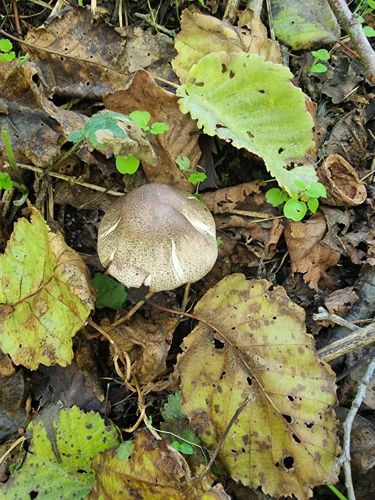
The Mosaic Puffball has a pear-shaped to club-shaped fruiting body, typically 5-15 cm tall and 3-8 cm wide. It is initially white, later becoming brownish. The surface is covered with irregular, flat, mosaic-like patches or scales, which are often shed, leaving a smoother surface. The flesh inside is initially firm and white, gradually turning yellowish-olive to brown and powdery as the spores mature. The base is often wrinkled or stalk-like.
Habitat & Growing Conditions
This fungus grows terrestrially on the ground, often in deciduous or mixed woodlands, meadows, and pastures. It is found in soil, among grass, or on leaf litter.
Season & Fruiting Time
It is typically found from summer to autumn, with fruiting often peaking in late summer and early autumn after sufficient rain.
Similar Looking Species
Other puffball species can look similar, especially in their early stages. The 'Mosaic Puffball' can be distinguished by the distinctive mosaic-like patches on its surface, which often fall off to leave a polygonal pattern. Pear-shaped Puffball (Lycoperdon pyriforme) is generally smaller, more uniformly pear-shaped, and typically grows on decaying wood, often in clusters. The Common Puffball (Lycoperdon perlatum) has more pronounced, conical spines covering its surface.
Ecological Role
Calvatia excipuliformis is a saprobic fungus, meaning it obtains nutrients by decomposing dead organic matter. It plays an important role in nutrient cycling in its ecosystems by breaking down leaf litter and other plant debris, thus returning essential nutrients to the soil.
Safety reminder
AI mushroom identification is a best-effort estimate and can be wrong. Never use it to decide whether a mushroom is safe to handle or eat — always confirm with a qualified mycologist before any consumption.
Identified on: 11/3/2025
Mode: Standard