Deer Mushroom
Pluteus cervinus
Type: gilled mushroom
Physical Characteristics
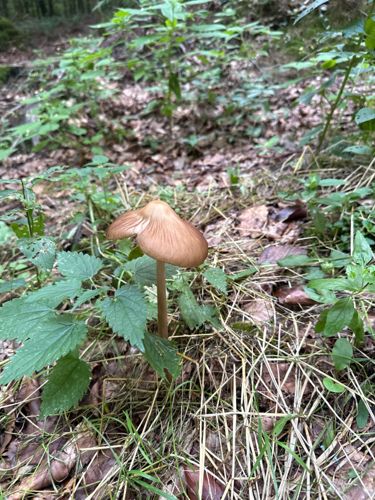
The cap is typically conical to bell-shaped, flattening with age, and can be various shades of brown, often with a paler margin. It has a smooth, sometimes finely striate surface when moist. The gills are adnate to adnexed, somewhat crowded, and initially whitish to cream, becoming pinkish to salmon-colored with age due to spore development. The stem is slender, often twisted, and colored similarly to the cap, sometimes paler towards the base. Spore print is pink.
Habitat & Growing Conditions
Found widely in woodlands, forests, and grassy areas, growing terrestrially on decaying organic matter or directly from the soil. Often associated with leaf litter and woody debris.
Season & Fruiting Time
Typically found from spring through autumn, often after periods of rain.
Similar Looking Species
Pluteus cervinus can be confused with other species within the genus Pluteus, which generally share the pink spore print. For example, Pluteus petasatus has a paler, more whitish-grey cap and is often found on wood chips. Another similar mushroom is Entoloma species, which also have pink spore prints, but their gills are typically sinuate or notched and they often have angular spores. Careful observation of microscopic features is key for accurate identification within these groups.
Ecological Role
Saprophytic, playing a vital role in nutrient cycling by decomposing organic matter such as leaf litter and woody debris. They return essential nutrients to the soil, contributing to forest health.
Safety reminder
AI mushroom identification is a best-effort estimate and can be wrong. Never use it to decide whether a mushroom is safe to handle or eat — always confirm with a qualified mycologist before any consumption.
Identified on: 7/23/2025
Mode: Standard