Haymaker Mushroom, Mowers Mushroom
Panaeolus foenisecii
Type: gilled mushroom
Physical Characteristics
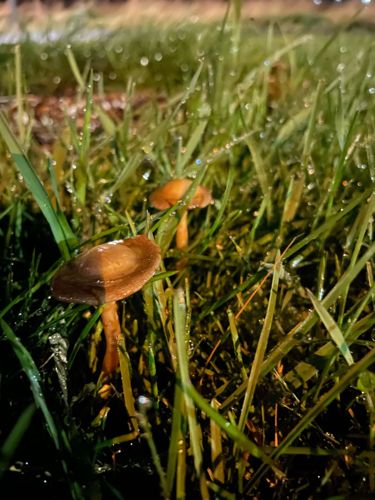
Cap is typically 1-4 cm in diameter, conic to campanulate (bell-shaped) when young, expanding to convex or nearly flat with age, often with a slight umbo (central bump). Color varies from light brown, reddish-brown, or cinnamon-brown when moist (hygrophanous) to a pale buff or tan when dry. The margin can be striate (grooved) when moist. Gills are adnate to adnexed, close, and become mottled brownish-black due to the maturing spores. The stem is slender, fragile, 4-12 cm long and 2-4 mm thick, colored similarly to the cap but often paler, and lacks a ring. Spore print is dark purplish-brown to black.
Habitat & Growing Conditions
Commonly found in lawns, grasslands, meadows, and other grassy areas, especially after rain. It grows scattered to gregariously, often in fertilized soil.
Season & Fruiting Time
Spring, summer, and autumn, often appearing after rain or during periods of moist weather.
Similar Looking Species
Can be confused with other small brown mushrooms found in grass, such as other species of Panaeolus (e.g., Panaeolus cinctulus, which has a darker cap and often a distinct darker band around the margin), Psathyrella species, and some Galerina species. Distinguishing features include its hygrophanous cap, mottled gills, and typical growth in lawns.
Ecological Role
Panaeolus foenisecii is a saprobic fungus, meaning it obtains nutrients by decomposing dead organic matter. It plays a role in nutrient cycling in grassy ecosystems by breaking down organic material in soil and thatch.
Safety reminder
AI mushroom identification is a best-effort estimate and can be wrong. Never use it to decide whether a mushroom is safe to handle or eat — always confirm with a qualified mycologist before any consumption.
Identified on: 9/28/2025
Mode: Standard