Shaggy Scalycap
Pholiota squarrosa
Type: Gilled mushroom
Physical Characteristics
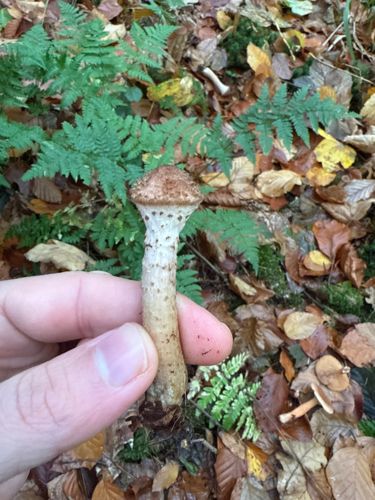
The Shaggy Scalycap has a cap that ranges from 5-20 cm in diameter, initially convex, becoming broadly convex to flat with age, and typically yellowish-brown to orange-brown. It is covered with prominent, rusty-brown to reddish-brown, shaggy scales. The gills are adnate to sinuate, crowded, and whitish to pale yellow when young, becoming rusty brown with age due to the spores. The stem is central, 5-20 cm long and 1-3 cm thick, solid, and often tapers towards the base. It is characteristically covered with shaggy scales below a prominent, often persistent, membranous ring that can darken with age from falling spores. The flesh is whitish to yellowish. The spore print is rusty brown.
Habitat & Growing Conditions
This mushroom is a saprobic and parasitic species, typically found growing in clusters on dead or living deciduous and coniferous wood, often at the base of trees or on stumps and logs. It prefers temperate climates.
Season & Fruiting Time
Primarily found from late summer through autumn, often after periods of rain.
Similar Looking Species
Similar looking species include other Pholiota species, such as Pholiota squarrosoides which has a stickier cap and more pointed scales. Another consideration is Armillaria mellea (Honey Fungus), which also grows in clusters on wood but typically has a less shaggy stem and a whitish spore print. Due to the shaggy scales, some Pholiota species can also superficially resemble some species of Agrocybe (e.g., Agrocybe praecox), but Agrocybe species typically have smoother stems and different cap textures.
Ecological Role
Pholiota squarrosa is a saprobic fungus, meaning it breaks down dead organic matter, playing a crucial role in nutrient cycling in forest ecosystems. It can also act as a weak parasite on living trees, causing white rot. Its decomposition activities contribute to soil health and structure.
Safety reminder
AI mushroom identification is a best-effort estimate and can be wrong. Never use it to decide whether a mushroom is safe to handle or eat — always confirm with a qualified mycologist before any consumption.
Identified on: 10/25/2025
Mode: Standard