Honey Fungus
Armillaria mellea
Type: Gilled mushroom
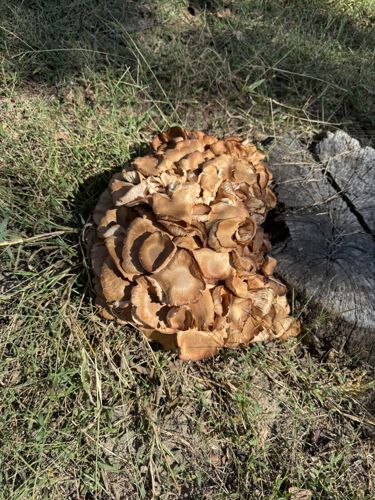
Physical Characteristics
Caps are typically honey-yellow to yellowish-brown, often darker towards the center, and can be scaly, especially when young. They range from 3-15 cm in diameter. The shape evolves from convex buttons to broad, flattened caps. Gills are adnate to decurrent, white to yellowish, sometimes developing reddish-brown spots with age. Stems are fibrous, 5-20 cm tall, with a persistent ring that is typically white to yellowish and has a cottony or fibrillose margin. Spore print is white.
Habitat & Growing Conditions
Honey fungus is a parasitic and saprobic organism, growing in dense clusters on a wide variety of hardwoods and conifers, often at the base of living trees, on stumps, or from buried roots. It causes white rot of wood.
Season & Fruiting Time
Late summer to late fall, typically after periods of rain.
Similar Looking Species
Several species of Armillaria look similar, often requiring microscopic examination or DNA sequencing for definitive identification. Galerina marginata (autumn skullcap) can look superficially similar, especially when young, but it typically has a darker spore print, lacks a prominent ring, and is found on dead wood. Phycousticia lateritia also shares resemblances, particularly in color and habitat.
Ecological Role
Armillaria mellea acts as a significant pathogen, causing root rot and butt rot in a wide range of trees and woody plants, leading to weakened growth, dieback, and eventual tree mortality. It is also a saprobe, decomposing dead wood and acting as a recycler of nutrients in forest ecosystems.
Safety reminder
AI mushroom identification is a best-effort estimate and can be wrong. Never use it to decide whether a mushroom is safe to handle or eat — always confirm with a qualified mycologist before any consumption.
Identified on: 10/7/2025
Mode: Standard