Gymnopilus penetrans
Gymnopilus penetrans
Type: gilled mushroom
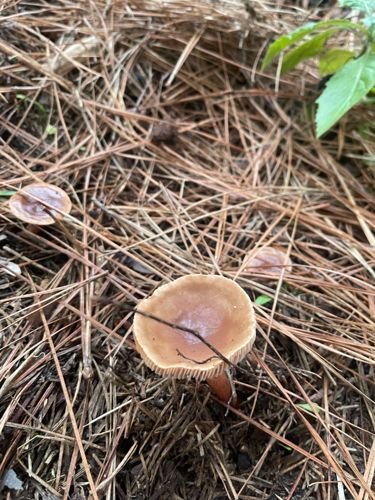
Physical Characteristics
The mushroom typically has a cap that is broadly convex to bell-shaped, sometimes with a slight umbo (a central raised point). The color can range from reddish-brown to cinnamon-brown, often fading to a lighter tan or yellowish-brown towards the margin when dry. The surface tends to be smooth and somewhat hygrophanous, meaning its color changes depending on moisture content. The gills are adnate to adnexed, close to crowded, and initially whitish to cream, becoming rusty brown as the spores mature. The stem is relatively slender, cylindrical, and can be the same color as the cap or slightly lighter, often with a fine powdery or fibrillose texture. A ring (annulus) may be present, often as a delicate, evanescent zone on young specimens.
Habitat & Growing Conditions
Often found growing gregariously or scattered on the ground, particularly in pine forests or mixed woodlands, among pine needles, wood chips, and other woody debris. It prefers acidic soil conditions rich in organic matter.
Season & Fruiting Time
Typically found from late spring through autumn, especially after periods of rain. Its fruiting season can extend into early winter in milder climates.
Similar Looking Species
Gymnopilus sapineus: Very similar in appearance and often confused, sometimes considered synonymous by some mycologists. Distinguishing features can be microscopic, such as spore size and ornamentation. Gymnopilus luteofolius: Has a more yellow to orange cap and greenish-yellow gills. Other small brown mushrooms: Many small brown mushrooms (LBMs) can look similar to the untrained eye, including species from genera like Cortinarius, Galerina, and Pholiota. Key distinguishing features for Gymnopilus penetrans include its rusty brown spore print, common habitat on woody debris, and the general cap and gill characteristics.
Ecological Role
It is a saprophytic fungus, meaning it obtains nutrients by decomposing dead organic matter. It plays a crucial role in nutrient cycling in forest ecosystems, breaking down leaf litter, wood debris, and other plant material, thereby returning essential nutrients to the soil for other organisms.
Safety reminder
AI mushroom identification is a best-effort estimate and can be wrong. Never use it to decide whether a mushroom is safe to handle or eat — always confirm with a qualified mycologist before any consumption.
Identified on: 7/22/2025
Mode: Standard