Porcelain Fungus
Oudemansiella mucida
Type: Gilled mushroom
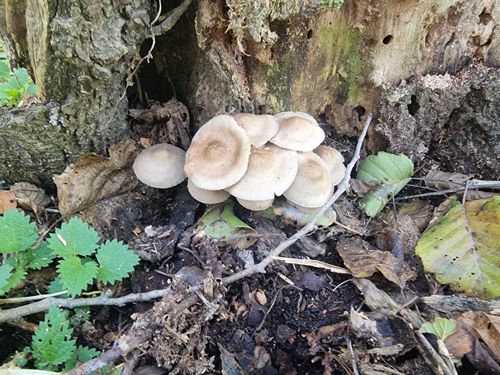
Physical Characteristics
Cap: 2-8 cm in diameter, initially convex, flattening with age, smooth and slimy, often pure white or with a slightly cream/pale brownish center. Gills: Broad, adnexed to adnate (attached to the stem), widely spaced, white. Stem: 3-10 cm long, 0.3-1 cm thick, white, often with a distinct ring (annulus) that can be thin and wispy, sometimes slightly sticky below the ring. Spore print: White. Flesh: White, thin, and brittle.
Habitat & Growing Conditions
Typically found in dense clusters on dead or decaying wood of broadleaf trees, especially beech (Fagus sylvatica). It acts as a saprophyte, breaking down lignin and cellulose in the wood.
Season & Fruiting Time
Late summer to late autumn, often after periods of rain.
Similar Looking Species
Due to its distinctive slimy, white cap and growth on wood, it is quite recognizable. However, some other white-capped fungi exist. *Gymnopus dryophilus* (Oak-loving Collybia) can have a somewhat similar cap shape and color but lacks the slime and the prominent annulus. *Leucopaxillus giganteus* can also be white and large but grows terrestrially and has much denser gills. The slime and substrate are key identifiers.
Ecological Role
It is a saprophytic fungus, meaning it obtains nutrients by decomposing dead organic matter. In this case, it plays a vital role in the breakdown of hardwood, particularly beech trees, contributing to nutrient cycling in forest ecosystems. It causes a white rot in the wood it colonizes.
Safety reminder
AI mushroom identification is a best-effort estimate and can be wrong. Never use it to decide whether a mushroom is safe to handle or eat — always confirm with a qualified mycologist before any consumption.
Identified on: 11/3/2025
Mode: Standard