Big Laughing Gym
Gymnopilus junonius
Type: gilled mushroom
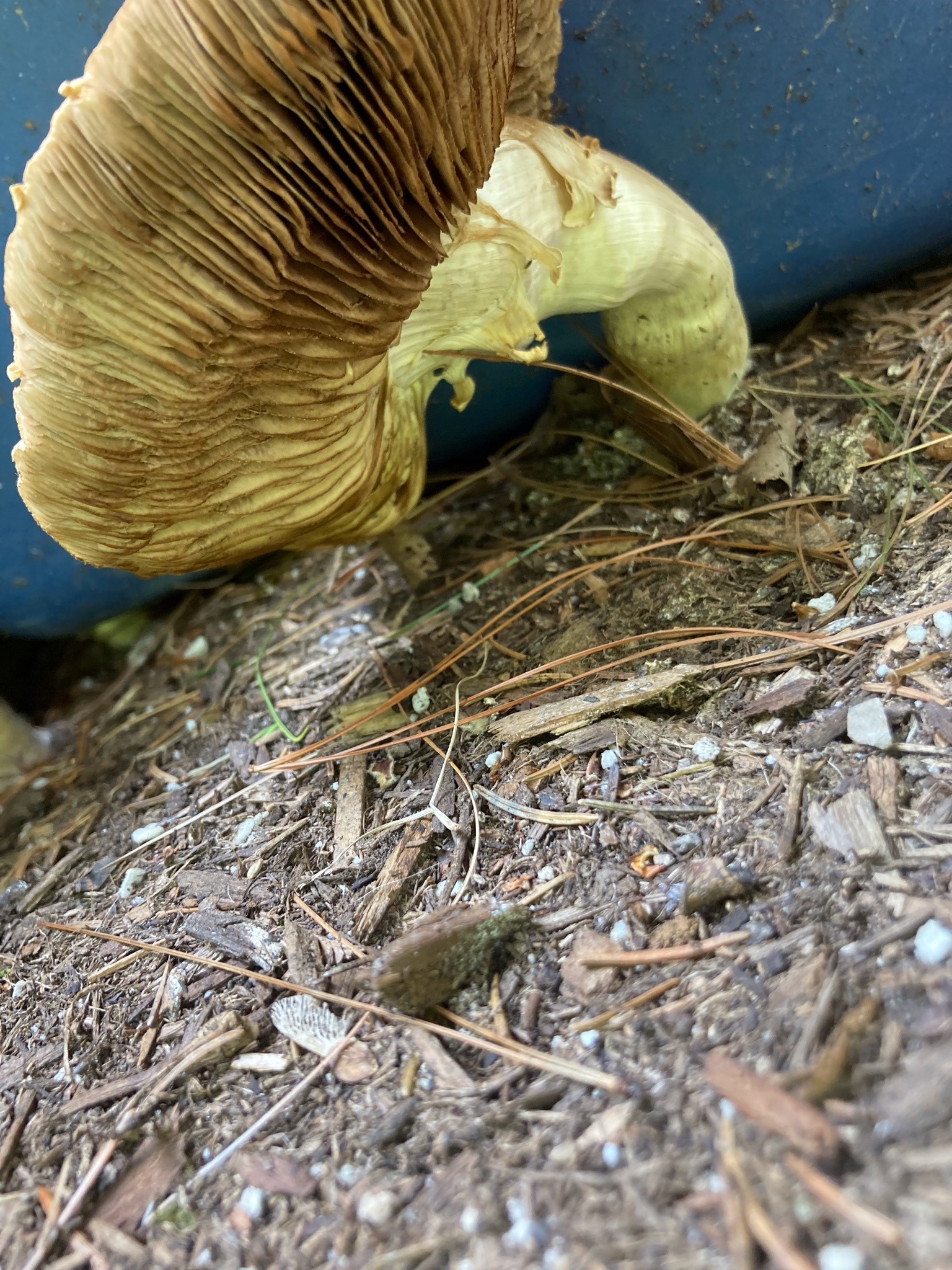
Physical Characteristics
Large, sturdy, orange to yellow-brown cap with fine scales. Broad, yellow-orange gills and a thick stipe with a distinct ring. Generally bitter taste.
Habitat & Growing Conditions
Grows in clusters on living and dead wood, or on buried stumps and roots of both hardwoods and conifers.
Season & Fruiting Time
Typically fruits in summer and autumn (late spring in warmer climates).
Similar Looking Species
Gymnopilus ventricosus (lacks bitterness, larger), Armillaria species (have white spore prints), Galerina marginata (much smaller, darker spore print, different ring).
Ecological Role
Saprophytic, breaking down wood and decaying tree stumps.
Fruiting Body
Cap is convex to flat, 5-20cm, yellow to orange with small scales. Gills are yellow, turning rusty brown with age. Stipe is 8-20cm long, often swollen in the middle, with a persistent membranous ring.
Size
Cap: 5-20cm diameter; Stipe: 8-20cm long, 1-5cm thick.
Spore Print
Rusty orange to rusty brown.
Distribution
Widely distributed across North America, Europe, Asia, and parts of the Southern Hemisphere.
Identification Tips
Check for the rusty orange spore print, the bitter taste of the flesh (spit out), and the cluster growth on wood with a clear ring on the stipe.
Interesting Facts
This species is part of a complex of similar-looking fungi and was historically named Pholiota spectabilis. It is often studied for its ability to produce enzymes that decompose lignin.
Safety reminder
AI mushroom identification is a best-effort estimate and can be wrong. Never use it to decide whether a mushroom is safe to handle or eat — always confirm with a qualified mycologist before any consumption.
Identified on: 5/19/2026
Mode: Standard