Fly Agaric
Amanita muscaria
Type: gilled mushroom
Physical Characteristics
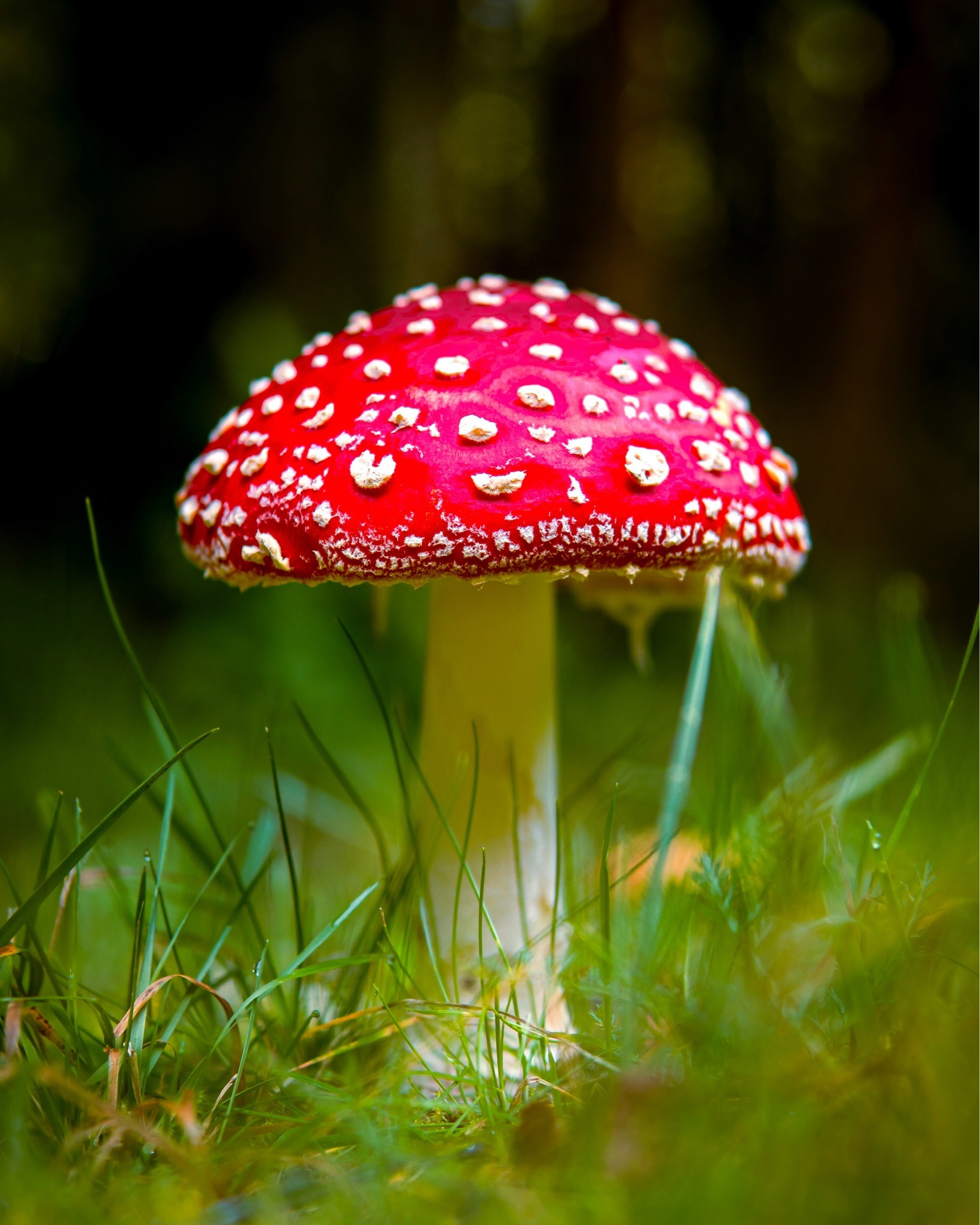
Bright red to orange cap covered with white, warty pyramidal scales; white gills and a white stem with a ring and a bulbous base with a volva.
Habitat & Growing Conditions
Typically found in woodlands, forming mycorrhizal relationships with both deciduous and coniferous trees like birch, pine, and spruce.
Season & Fruiting Time
Late summer to late autumn, often following periods of heavy rain.
Similar Looking Species
Amanita caesarea (lacks white warts), Amanita pantherina (browner cap), and Amanita parcivolvata (lacks a ring).
Ecological Role
Mycorrhizal; it forms a symbiotic relationship with tree roots, aiding in nutrient and water uptake for the tree while receiving sugars in return.
Fruiting Body
Cap is initially globose, then hemispherical to flat; surface is scarlet red with white universal veil remnants (warts). Hymenophore consists of free, white, crowded gills. Stipe is white, cylindrical, featuring a white pendulous ring and a basal bulb encased in woolly rings of veil material.
Size
Cap diameter: 8–20 cm (3–8 in); Stipe height: 5–20 cm (2–8 in); Stipe diameter: 1–2 cm (0.5–1 in).
Spore Print
White
Distribution
Originally native to temperate and boreal regions of the Northern Hemisphere, it has been unintentionally introduced to many parts of the Southern Hemisphere.
Identification Tips
Look for the distinctive red cap with white warts, white free gills, and a large basal bulb with concentric rings of veil remnants. Always check the base of the stem.
Interesting Facts
This species is the iconic 'toadstool' frequently depicted in folklore, fairy tales, and video games. It is also well-known for its relationship with the reindeer in northern cultures and its use in historical fly traps, where crumbled pieces were placed in milk to attract and stun houseflies.
Safety reminder
AI mushroom identification is a best-effort estimate and can be wrong. Never use it to decide whether a mushroom is safe to handle or eat — always confirm with a qualified mycologist before any consumption.
Identified on: 4/18/2026
Mode: Standard