Velvet-footed Pax
Tapinella atrotomentosa
Type: Gilled mushroom
Physical Characteristics
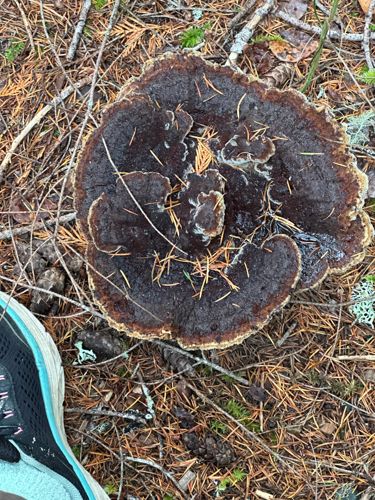
The cap of Tapinella atrotomentosa is typically large, ranging from 10 to 30 cm in diameter, and often irregularly shaped to somewhat kidney-shaped. Its color is dark brown to blackish-brown, sometimes with lighter margins, and the surface can be velvety or finely hairy when young, becoming smoother with age. The margin is often inrolled when young and can become wavy or lobed. The gills are cream to yellowish or buff, decurrent (running down the stem), and often forked. They are easily separable from the cap flesh. The stem is short, thick, and typically off-center or lateral, covered in a distinctive dark brown to blackish-brown, dense, velvety to woolly mycelial covering, which gives it its common name. The flesh is pale yellow to buff, firm, and does not change color significantly when cut. Spore print is yellow-brown to rusty brown. Size can be quite substantial.
Habitat & Growing Conditions
This mushroom is saprophytic, growing on decaying coniferous wood, particularly stumps, buried wood, or logs. It can be found singly or in small groups in mixed or coniferous forests. It prefers logs and stumps of pine, fir, and spruce.
Season & Fruiting Time
Typically found from summer to late autumn, sometimes extending into early winter in milder climates, especially after periods of rain.
Similar Looking Species
Similar species generally include other members of the Tapinella genus or some Paxillus species, though the distinctly velvety dark stem is a key distinguishing feature for Tapinella atrotomentosa. Paxillus involutus has a different cap texture and lacks the distinctively velvety stem.
Ecological Role
Tapinella atrotomentosa is a saprophyte, meaning it plays a crucial role in breaking down dead organic matter, specifically decaying wood. It recycles nutrients back into the forest ecosystem, contributing to soil health and supporting other forest organisms. Its ability to decompose woody materials helps to clear forest floors and facilitate new growth. It causes a brown rot in the wood it colonizes, selectively breaking down cellulose and hemicellulose, leaving lignin behind.
Safety reminder
AI mushroom identification is a best-effort estimate and can be wrong. Never use it to decide whether a mushroom is safe to handle or eat — always confirm with a qualified mycologist before any consumption.
Identified on: 10/12/2025
Mode: Standard