Sulfur Tuft
Hypholoma fasciculare
Type: gilled mushroom
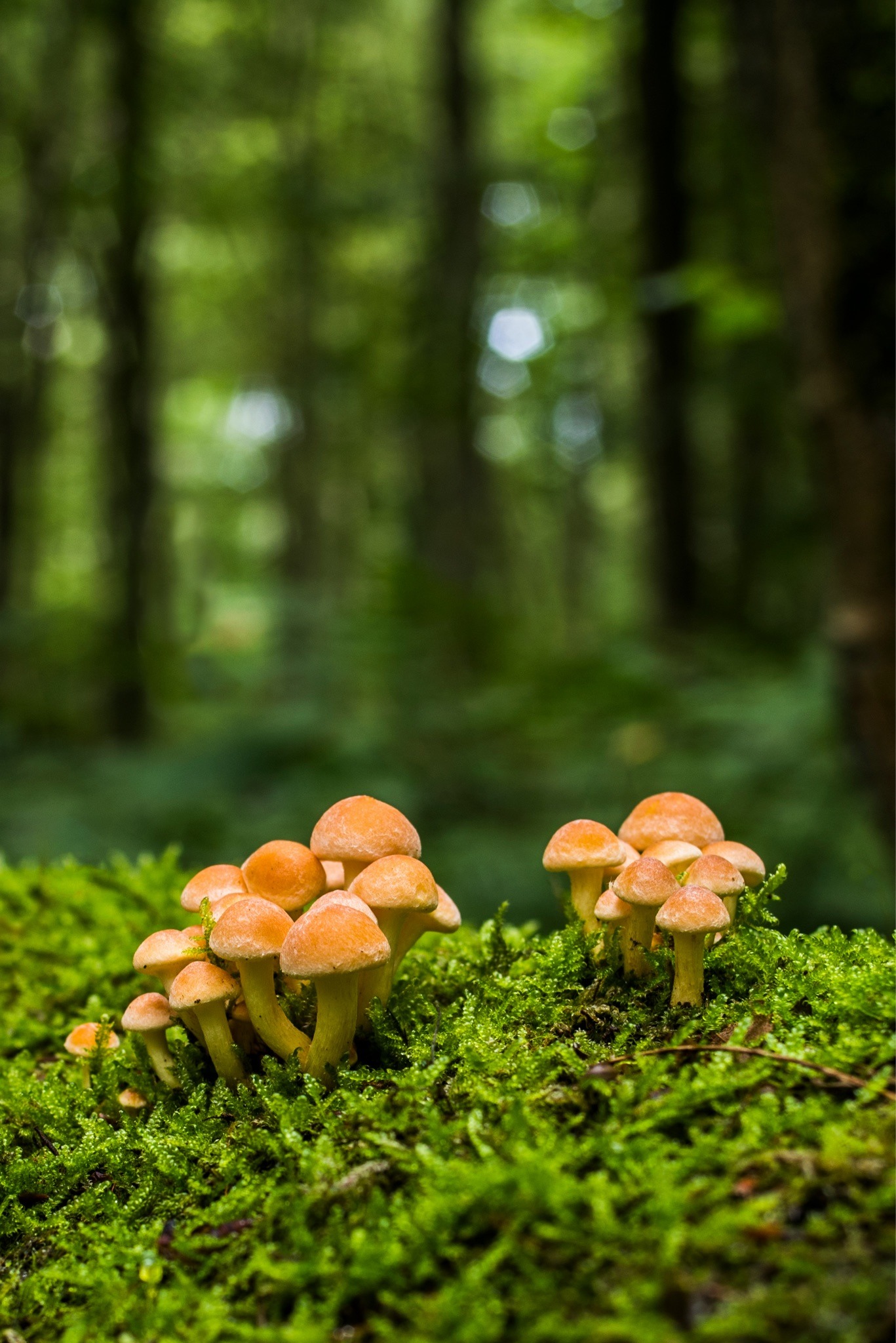
Physical Characteristics
Gregarious and caespitose growth habit (found in dense clusters). The caps are typically bright sulfur-yellow, often with orange or reddish centers. Gills are initially yellow, turning a characteristic greenish-yellow and eventually olive-brown or dark brown as spores mature.
Habitat & Growing Conditions
Grows primarily on decaying wood of both broadleaf and coniferous trees. It is often found on stumps, buried roots, or logs.
Season & Fruiting Time
Common from late spring through late autumn, and sometimes into winter in milder climates.
Similar Looking Species
Hypholoma capnoides (lacks greenish tints in gills), Hypholoma lateritium (Brick Cap), and Galerina marginata (Funeral Bell).
Ecological Role
Saprophytic; it plays a vital role in decomposing dead wood and recycling nutrients back into the forest soil.
Fruiting Body
Cap is convex to flat, 2–6 cm wide, smooth, sulfur-yellow with an orange-brown center. Gills are crowded and adnate, starting yellow and darkening to olive-green. Stipe is 5-10 cm long, slender, often curved, yellow, and may have a faint, dark ring zone from falling spores.
Size
Cap: 2–6 cm diameter; Stipe: 3–10 cm length, 0.4–1 cm width.
Spore Print
Purple-brown to dark brown.
Distribution
Widespread across Europe and North America, and found in many other temperate regions globally.
Identification Tips
Look for the dense clustering on wood and the distinct greenish tint of the gills, which is rare in other gilled mushrooms. The very bitter taste of the flesh is a diagnostic feature used by mycologists.
Interesting Facts
Hypholoma fasciculare is one of the most common and widely distributed wood-rotting fungi in temperate forests. Its name 'fasciculare' refers to the way the mushrooms grow in bundles or 'fascicles'.
Safety reminder
AI mushroom identification is a best-effort estimate and can be wrong. Never use it to decide whether a mushroom is safe to handle or eat — always confirm with a qualified mycologist before any consumption.
Identified on: 4/18/2026
Mode: Standard