Honey Fungus
Armillaria mellea
Type: gilled mushroom
Physical Characteristics
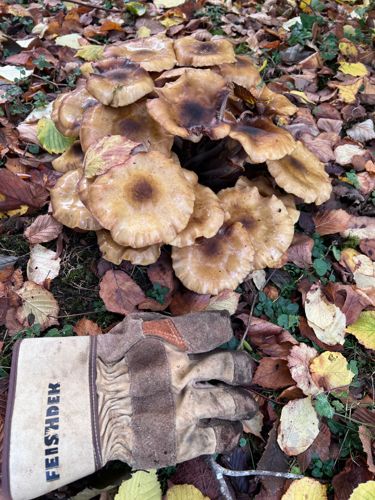
Caps are typically 5-15 cm in diameter, honey-yellow to yellowish-brown, often darker towards the center, smooth but can have small, darker scales, especially when young. They are convex, flattening with age, sometimes with an uplifted margin. Gills are adnexed to decurrent, white to yellowish, often staining rusty brownish with age. Stems are 5-20 cm long and 1-3 cm thick, fibrous, yellowish-brown, often darker at the base, typically with a persistent, felt-like ring (annulus) that can be white or yellowish and often thick-margined. Spore print is white to creamy white. They grow in dense clusters.
Habitat & Growing Conditions
Parasitic and saprophytic on a wide range of deciduous and coniferous trees, both living and dead. Often found growing from the base of trees or from buried wood. Can cause white rot in wood.
Season & Fruiting Time
Late summer to late autumn, particularly after periods of rain.
Similar Looking Species
Similar species include other Armillaria species (e.g., Armillaria ostoyae, Armillaria gallica) which can be distinguished by microscopic features, presence/absence of an annulus, and host tree preference. Galerina marginata (Deadly Galerina) is a deadly toxic species that can be mistaken for Armillaria species, especially when growing on wood; it has a brown spore print and lacks the thick ring of Armillaria. Pholiota species also bear some resemblance but have brown spore prints.
Ecological Role
Armillaria mellea can be a significant forest pathogen, causing root rot and white rot in numerous tree species, leading to their decline and death. It also acts as a saprophyte, decomposing dead wood and recycling nutrients back into the ecosystem. The fungus produces bioluminescent mycelium, sometimes visible as 'foxfire' in decaying wood.
Safety reminder
AI mushroom identification is a best-effort estimate and can be wrong. Never use it to decide whether a mushroom is safe to handle or eat — always confirm with a qualified mycologist before any consumption.
Identified on: 10/28/2025
Mode: Standard