Rough-stemmed Bolete / Scaber Stalk
Leccinum species (e.g., Leccinum scabrum, Leccinum duriusculum, Leccinum versipelle – specific species difficult to determine from image alone)
Type: Bolete
Physical Characteristics
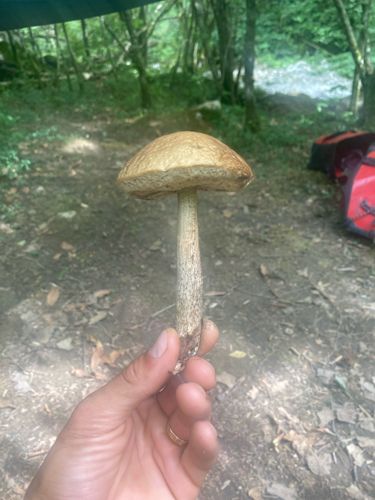
The mushroom in the image appears to be a Leccinum species, commonly known as a Rough-stemmed Bolete or Scaber Stalk. Key physical characteristics for Leccinum species generally include: a cap ranging from tan to various shades of brown, often convex to broadly convex or cushion-shaped; the underside of the cap has pores instead of gills, typically white or light grey when young, darkening with age or bruising. The most distinctive feature is the stem, which is usually paler than the cap and covered with small, shaggy, dark scales or scabers (hence 'scaber stalk'). The stem is often tapering slightly upwards or cylindrical, and can be quite robust. The flesh is usually white, though it may change color (often to grey, pinkish, or bluish) when cut or bruised, depending on the specific species.
Habitat & Growing Conditions
Leccinum species are typically found growing on the ground in woodlands and forests, forming mycorrhizal associations with various deciduous and coniferous trees. Common tree associates include birch (Betula), aspen (Populus), oak (Quercus), and conifers like pine (Pinus) and spruce (Picea), depending on the specific Leccinum species. They prefer well-drained soil and often appear in disturbed areas or along forest paths, as seen in the image.
Season & Fruiting Time
Leccinum species are generally found from late spring through autumn, with peak fruiting often occurring in late summer and early autumn after periods of rain. Their appearance is dependent on temperature, moisture, and the availability of suitable host trees.
Similar Looking Species
There are numerous Leccinum species, and many share similar appearances, making specific identification challenging without microscopic examination or more detailed features. Some common look-alikes include other Leccinum species, which can often be distinguished by their host tree association (e.g., birch, oak, aspen), subtle differences in cap color/texture, and differences in flesh staining reactions. For example, Leccinum scabrum (common bolete) is associated with birch, while Leccinum versipelle (orange birch bolete) has an orange cap and distinct scabers. Other boletes, such as species of Boletus or Suillus, might appear superficially similar but lack the characteristic dark scabers on the stem.
Ecological Role
Leccinum species are mycorrhizal, meaning they form a symbiotic relationship with the roots of certain trees. They exchange nutrients and water with the tree, receiving sugars produced by the tree through photosynthesis. This symbiotic relationship is crucial for the health and growth of both the fungus and the host tree, contributing significantly to forest ecosystems.
Safety reminder
AI mushroom identification is a best-effort estimate and can be wrong. Never use it to decide whether a mushroom is safe to handle or eat — always confirm with a qualified mycologist before any consumption.
Identified on: 7/23/2025
Mode: Standard