Tiger's Eye Polypore
Trametes versicolor
Type: Polypore
Physical Characteristics
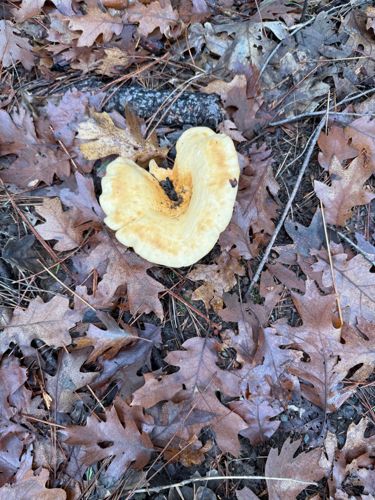
Caps are thin, leathery, and fan-shaped, often zoned with concentric rings of various colors like brown, tan, gray, black, and white. The surface can be velvety or finely hairy. The underside has small pores rather than gills, which are typically white or yellowish-white. The margin is often wavy or lobed. It is a smaller polypore, usually 2-8 cm across.
Habitat & Growing Conditions
Typically found on decaying hardwood, logs, stumps, and fallen branches. It is a very common and widespread species, found in woodlands and forests.
Season & Fruiting Time
Found year-round in many climates, but most prolific during warmer, wetter months. It can persist through winter.
Similar Looking Species
There are several other species of Trametes and Stereum that can look similar. Stereum ostrea (False Turkey Tail) lacks pores on the underside, having a smooth or wrinkled surface instead. Trametes hirsuta is usually thicker, grayer, and has a hairier upper surface. Trametes pubescens is paler and has a finely velvety cap.
Ecological Role
This mushroom is a saprophytic fungus, meaning it breaks down dead wood. It plays a crucial role in nutrient cycling in forest ecosystems by decomposing lignin and cellulose in fallen trees and branches, returning organic matter to the soil.
Safety reminder
AI mushroom identification is a best-effort estimate and can be wrong. Never use it to decide whether a mushroom is safe to handle or eat — always confirm with a qualified mycologist before any consumption.
Identified on: 11/19/2025
Mode: Standard