Thin-maze Flat Polypore
"Daedaleopsis confragosa"
Type: Polypore
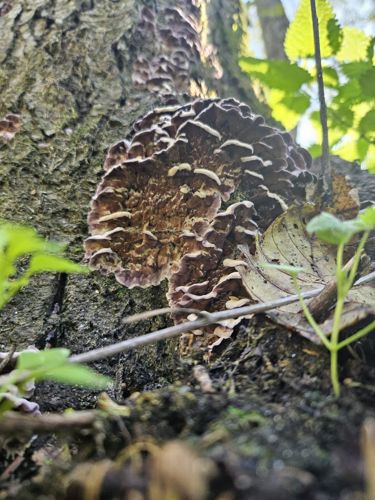
Physical Characteristics
The cap of "Daedaleopsis confragosa" is typically fan-shaped, semicircular, or kidney-shaped, often zoned with shades of gray, brown, or reddish-brown. The upper surface can be hairy to smooth. The pore surface, which is crucial for identification, varies from labyrinthine (maze-like) to daedaloid (maze-like with elongated, slit-like pores) to lamellate (gill-like) or even poroid (round pores). The color of the pore surface is typically whitish to grayish-brown, often bruising reddish or brownish where handled. It is a tough, woody fungus when mature and can grow quite large, sometimes up to 20 cm across. The flesh is buff to pale brown.
Habitat & Growing Conditions
This polypore is a common saprophyte, growing on the dead wood of a wide range of deciduous trees, particularly willow, birch, oak, and beech. It can also be found on standing dead trees or fallen logs. It is particularly common in disturbed woodlands, alongside paths, and in parks, preferring moist environments.
Season & Fruiting Time
It is typically found year-round, as its fruiting bodies are perennial. However, new growth and spore production are most active from late spring through late autumn, especially after periods of rain.
Similar Looking Species
"Trametes suaveolens" (Fragrant Bracket) has a distinct sweet anise odor, which "Daedaleopsis confragosa" lacks. "Daedalea quercina" (Oak Maze Gill) has consistently larger, more distinctly maze-like pores and usually grows on oak. "Lenzites betulina" (Gilled Polypore) has a truly gilled underside, but the gills are tougher and more widely spaced than typical mushroom gills; its cap is often more distinctly zonate with varied colors. Key distinguishing features for "Daedaleopsis confragosa" are its variable pore surface (often maze-like to gill-like), which bruises reddish-brown, and its tough, thin flesh.
Ecological Role
"Daedaleopsis confragosa" is a saprophytic fungus, meaning it breaks down dead wood, particularly lignin, acting as a white-rot decomposer. This process is crucial for nutrient cycling in forest ecosystems, returning organic matter to the soil and helping to create habitats for other organisms. It plays an important role in the decomposition of hardwood trees.
Safety reminder
AI mushroom identification is a best-effort estimate and can be wrong. Never use it to decide whether a mushroom is safe to handle or eat — always confirm with a qualified mycologist before any consumption.
Identified on: 11/3/2025
Mode: Standard