Green-spored Parasol
Chlorophyllum molybdites
Type: gilled mushroom
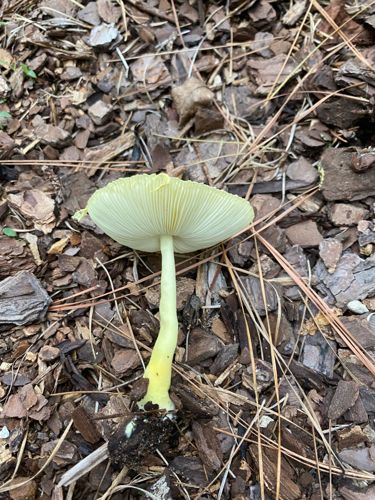
Physical Characteristics
Cap: 8-30 cm broad, convex to flat, white to brownish with brownish scales, especially in the center. Gills: Free from the stalk, closely spaced, white initially, becoming greenish due to the spores. Stalk: 10-25 cm long, 1-3 cm thick, white to brownish, tapering slightly upwards, with a large, double, movable ring. Spore print: Dull green. Flesh: White, often staining reddish-brown when cut or bruised.
Habitat & Growing Conditions
Typically found growing in lawns, parks, meadows, and disturbed grassy areas, often in scattered groups or fairy rings. It is saprobic, meaning it derives nutrients from decaying organic matter in the soil.
Season & Fruiting Time
Commonly found during warmer months, from summer through early autumn, particularly after rainfall.
Similar Looking Species
Similar-looking species include other large white-capped parasol mushrooms like Macrolepiota procera (Parasol Mushroom) or Leucoagaricus leucothites (White Dapperling). A key distinguishing feature of Chlorophyllum molybdites is its greenish spore print, which is absent in Macrolepiota procera (white spore print) and Leucoagaricus leucothites (white spore print). The ring on Chlorophyllum molybdites is also often movable.
Ecological Role
As a saprobic fungus, Chlorophyllum molybdites plays a role in decomposition, breaking down organic matter in the soil and recycling nutrients back into the ecosystem.
Safety reminder
AI mushroom identification is a best-effort estimate and can be wrong. Never use it to decide whether a mushroom is safe to handle or eat — always confirm with a qualified mycologist before any consumption.
Identified on: 9/7/2025
Mode: Standard