Rooting Shank
Hymenopellis radicata (formerly Xerula radicata)
Type: gilled mushroom
Physical Characteristics
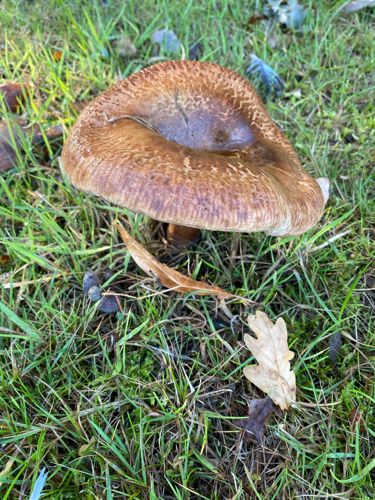
The cap of Hymenopellis radicata is typically 4-12 cm across, though it can occasionally reach up to 20 cm. It starts convex, becoming broadly convex or flat with age, often retaining a central broad umbo (a raised, rounded center). The color varies from pale tan or grayish-brown to dark brown or olive-brown, often paler towards the margin. The surface is distinctly radially wrinkled or grooved, especially when mature, and can be viscid (slimy) when moist, becoming shiny when dry. The gills are adnexed or free, broad, distant, and white to cream-colored. The stem is slender but tough, 5-20 cm long and 0.5-2 cm thick, often tapering slightly upwards or downwards, and typically the same color as the cap or paler. Its most distinguishing feature is a long, root-like extension (pseudorhiza) that penetrates deep into the substrate to connect with buried wood. The spore print is white.
Habitat & Growing Conditions
This mushroom is saprobic, growing on the decaying wood of hardwoods, particularly oak, beech, and maple. It is found solitary or scattered, often on lawns, roadsides, or woodland edges where buried wood is present.
Season & Fruiting Time
Late spring through autumn, especially after periods of rain.
Similar Looking Species
There are other species within the genus Hymenopellis that can look similar, such as Hymenopellis furfuracea, which has a more granular or scaly cap and typically a less prominent pseudorhiza. Oudemansiella longipes is another species with a very long stem but lacks the distinctly wrinkled cap and often has hairs on the stem. Always confirm identification with multiple features, including the pseudorhiza.
Ecological Role
Hymenopellis radicata is a saprobic fungus, meaning it obtains nutrients by decomposing dead organic matter, specifically buried hardwood. It plays an important role in the forest ecosystem by breaking down fallen trees and other woody debris, thus recycling nutrients back into the soil and contributing to soil health.
Safety reminder
AI mushroom identification is a best-effort estimate and can be wrong. Never use it to decide whether a mushroom is safe to handle or eat — always confirm with a qualified mycologist before any consumption.
Identified on: 9/21/2025
Mode: Standard