Honey Fungus
Armillaria mellea
Type: gilled mushroom
Physical Characteristics
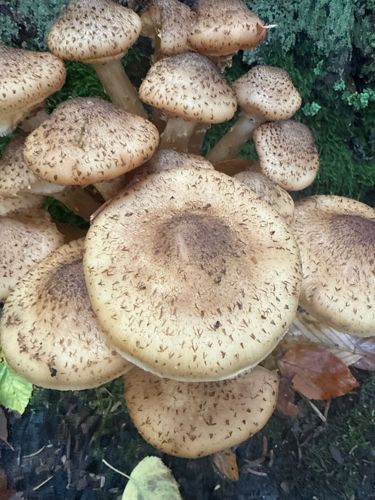
Caps typically 3-15 cm across, convex to flat, often with a central umbo, yellow-brown to brown, covered with small, dark, fibrous scales. Gills are adnate to decurrent, white to creamy, darkening with age. Stems are 5-20 cm long, 1-3 cm thick, fibrous, often narrowing towards the base, same color as the cap or lighter, with a persistent white to yellowish ring (annulus) that often has a thick, cottony texture. Spore print is white to cream.
Habitat & Growing Conditions
Found in clusters on living or dead wood of many deciduous and coniferous trees, stumps, and buried roots. They are parasitic on living trees and saprobic on dead wood.
Season & Fruiting Time
Late summer to late autumn, often after periods of rain.
Similar Looking Species
Several species of Armillaria are morphologically similar and are often grouped under the common name 'Honey Fungus'. Galerina marginata (Autumn Skullcap) is a deadly toxic mushroom that can sometimes grow on wood and resemble young honey fungi, but it typically has a brown spore print and lacks the prominent ring of Armillaria mellea. Pholiota squarrosa (Shaggy Scalycap) is another similar looking species, but it has a less prominent ring and typically grows on wood. Desarmillaria tabescens (Ringless Honey Fungus) looks very similar but lacks a ring on the stem.
Ecological Role
A significant parasitic fungus, causing white rot on tree roots and butts, leading to tree decline and death. It also acts as a saprophyte, decomposing dead wood, returning nutrients to the soil. It spreads via rhizomorphs ('bootlaces'), which are root-like structures that can travel through soil to infect new hosts.
Safety reminder
AI mushroom identification is a best-effort estimate and can be wrong. Never use it to decide whether a mushroom is safe to handle or eat — always confirm with a qualified mycologist before any consumption.
Identified on: 10/25/2025
Mode: Standard