Tinder Conk and Turkey Tail
Fomes fomentarius and Trametes versicolor
Type: polypore
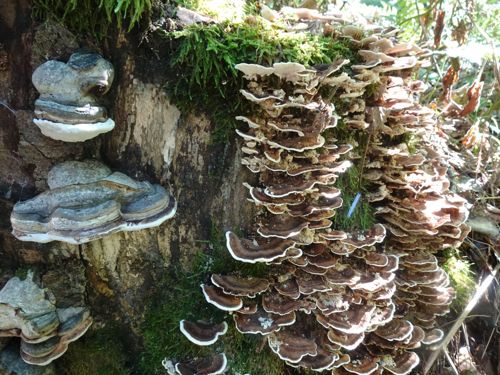
Physical Characteristics
The image displays two distinct types of polypores growing on a tree stump. On the left, there are larger, hoof-shaped or shelf-like brackets that appear to be Fomes fomentarius (Tinder Conk). These have a hard, woody texture, typically grey to brownish caps with concentric growth rings, and a smooth, whitish underside (pore surface). They generally lack a stipe. On the right, there is a cluster of smaller, thin, fan-shaped or semicircular brackets, consistent with Trametes versicolor (Turkey Tail). These fungi have velvety caps with distinct concentric zones of varying colors, often including brown, tan, gray, and white. The underside is typically white to cream-colored with very fine pores, not gills. They are sessile or have a very short, inconspicuous attachment to the substrate.
Habitat & Growing Conditions
Both Fomes fomentarius and Trametes versicolor are typically found growing on dead or dying hardwood trees, logs, and stumps. Fomes fomentarius prefers deciduous trees like birch, beech, maple, and oak. Trametes versicolor is highly adaptable and can be found on a wide variety of dead wood, including hardwood and conifers.
Season & Fruiting Time
Both species are perennial, meaning they can be found year-round, as their fruiting bodies can persist for multiple seasons. New growth and sporulation typically occur during periods of high humidity and moderate temperatures, often from late spring through fall.
Similar Looking Species
Fomes fomentarius can be confused with other large, shelf-like polypores such asartist's conk (Ganoderma applanatum), which has a darker pore surface that bruises brown, or various Phellinus species, which often have a more cracked or rugged top surface. Turkey Tail (Trametes versicolor) is frequently confused with other similar-looking crust fungi or polypores, such as Stereum ostrea (False Turkey Tail), which lacks pores on its underside and has a smoother surface, and Trichaptum biforme (Violet-pored Polypore), which has purple pores and often spine-like teeth on its pore surface when older. The key distinguishing feature for Trametes versicolor is its very fine, white pores and the distinct velvety, multicoloured zonation on the cap.
Ecological Role
Both species are saprophytic, meaning they obtain nutrients by decomposing dead organic matter. Fomes fomentarius causes white rot in dead or dying hardwood trees, breaking down lignin. Trametes versicolor also causes white rot and is a common decomposer of dead hardwood and sometimes conifer wood. These fungi play a crucial role in nutrient cycling and wood decomposition in forest ecosystems, returning organic matter to the soil.
Safety reminder
AI mushroom identification is a best-effort estimate and can be wrong. Never use it to decide whether a mushroom is safe to handle or eat — always confirm with a qualified mycologist before any consumption.
Identified on: 9/1/2025
Mode: Standard