Brown Mottlegill or Fragile Inky Cap
Psathyrella candolleana
Type: gilled mushroom
Physical Characteristics
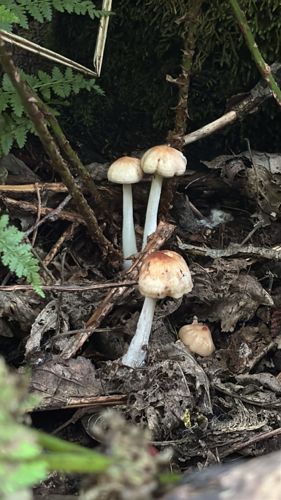
The species typically has a cap that starts conical or bell-shaped and flattens with age, often retaining a central umbo. The cap can range from light brown to tan, sometimes with darker striations towards the margin, and may become lighter when dry (hygrophanous). The gills are adnate to adnexed, close, and whitish to pale gray, darkening with age as spores mature. The stem is slender, whitish to pale, and rather delicate, often hollow, without a prominent ring. Spore print color is typically dark purple-brown to blackish. Size can vary but caps are generally 1-5 cm in diameter.
Habitat & Growing Conditions
Found widely distributed, growing saprophytically on decaying wood, leaf litter, well-rotted logs, wood chips, and other woody debris, often in disturbed areas, gardens, parks, and forests. They prefer moist conditions.
Season & Fruiting Time
Typically found from spring to late autumn, often appearing after rain. Its fruiting can be quite prolific during periods of high humidity and moderate temperatures.
Similar Looking Species
Psathyrella candolleana can be confused with other species within the genus Psathyrella, which are often difficult to distinguish without microscopic examination. Other brown-capped, fragile saprophytic mushrooms like certain species of Coprinellus or Panaeolus might appear similar, but their gill deliquescence (melting), spore print color, or cap characteristics usually differ upon closer inspection. The lack of a true ring and its fragile nature help differentiate it from some look-alikes.
Ecological Role
Psathyrella species are saprophytic, meaning they obtain nutrients by breaking down dead organic matter. They play a crucial role as decomposers in terrestrial ecosystems, returning nutrients from dead wood, leaves, and other plant debris back into the soil, thereby contributing to nutrient cycling.
Safety reminder
AI mushroom identification is a best-effort estimate and can be wrong. Never use it to decide whether a mushroom is safe to handle or eat — always confirm with a qualified mycologist before any consumption.
Identified on: 7/29/2025
Mode: Standard