Clustered Bonnet
Mycena inclinata
Type: gilled mushroom
Physical Characteristics
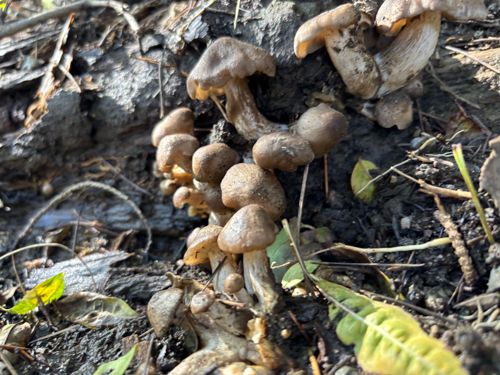
Caps are typically convex to broadly convex or nearly flat with age, often with a slight umbo. Color ranges from light to dark brown, sometimes with an olive or grayish tint, often paler towards the margin. The surface is smooth and moist, sometimes somewhat hygrophanous (changing color with moisture). Gills are attached to adnexed, close to crowded, and initially whitish to yellowish, becoming brown from maturing spores. The stem is slender, often curved or wavy, typically paler than the cap, and may have fine fibrils or be smooth. There is often no distinct ring. Spore print is brown.
Habitat & Growing Conditions
Typically found growing in dense clusters on decaying hardwood, occasionally on conifers. They can be found on stumps, logs, and buried wood. Prefers damp, shaded environments in woodlands.
Season & Fruiting Time
Late summer to late autumn, often appearing after rainfall.
Similar Looking Species
Similar species include other Mycena species, which can be difficult to distinguish without microscopic examination. Mycena galericulata is another common clustered Mycena that can look similar but usually has broader gills and lacks the distinct odor of M. inclinata. Careful observation of cap shape, gill attachment, stem characteristics, and odor are important for identification.
Ecological Role
Saprophytic, playing a crucial role in breaking down dead organic matter, particularly wood. They contribute to nutrient cycling in forest ecosystems by decomposing lignocellulose.
Safety reminder
AI mushroom identification is a best-effort estimate and can be wrong. Never use it to decide whether a mushroom is safe to handle or eat — always confirm with a qualified mycologist before any consumption.
Identified on: 7/22/2025
Mode: Standard