Oyster Mushroom
Pleurotus ostreatus
Type: gilled mushroom
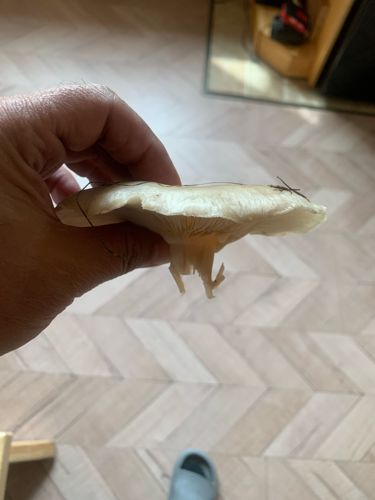
Physical Characteristics
The cap of this mushroom appears to be fan-shaped to spatulate, typical of an oyster mushroom. The color is a light cream or off-white. The gills are decurrent, meaning they run down the stem or attachment point, and are close together. There does not appear to be a distinct central stem; rather, it has a short, stout, and sometimes almost absent stem or a lateral attachment. The texture of the cap is generally smooth, though the image does not provide enough detail to determine if it is moist or dry. The size cannot be definitively determined without a reference, but it fits within the typical range for an oyster mushroom being held.
Habitat & Growing Conditions
Oyster mushrooms are typically found growing in shelves or clusters on decaying hardwood trees, logs, and stumps. They prefer deciduous trees, but can occasionally be found on conifers. They can grow on a wide variety of wood substrates, showing adaptability to different environments. This particular specimen's habitat cannot be confirmed from the image alone, as it is being held indoors.
Season & Fruiting Time
Generally found from late spring through fall, and sometimes even in mild winters. Their fruiting is often triggered by cool temperatures and moisture following rainfall. They are known to fruit in flushes.
Similar Looking Species
Similar looking species include other members of the Pleurotus genus, such as the Veiled Oyster Mushroom (Pleurotus dryinus) which has a veil, and the Golden Oyster Mushroom (Pleurotus citrinopileatus) which is brightly yellow. The Aspen Oyster Mushroom (Pleurotus populinus) is very similar and grows specifically on aspen. They can also be confused with Crepidotus species (which are typically smaller and have brown spore prints) and some types of white fan-shaped fungi. Distinguishing features include the decurrent gills, the generally eccentric or absent stem, the habit of growing in shelves or clusters on wood, and spore print color (white to lilac-gray for Pleurotus ostreatus). A notable distinguishing feature of true oyster mushrooms is their distinctive, somewhat fishy or aniselike odor, which is not ascertainable from an image alone. Another key differentiator is the lack of a prominent stem in most variations of Pleurotus ostreatus, unlike many other gilled mushrooms that grow from the ground or have a more central stem on wood. The gills are also typically somewhat thick and broad for their size, and often widely spaced relative to some other gilled species found on wood. The presence of lamellulae (short gills) is also a characteristic of Pleurotus species, though not easily visible here to confirm the exact species with certainty from this image alone. However, the overall morphology strongly points to a species within Pleurotus, most commonly Pleurotus ostreatus due to its widespread nature and appearance in the image, assuming it is a common type of oyster mushroom. Certain Lentinus species can also look similar, but often have tougher, leathery caps and serrated gill edges (though this varies). Distinguishing features for Lentinus species would include their tougher texture and often lacking the characteristic decurrent gills and broad fan shape of Pleurotus ostreatus to the same extent, but it's a possibility that would require closer examination for definitive identification.
Ecological Role
Oyster mushrooms are primarily saprophytic, meaning they obtain nutrients by decomposing dead organic matter. They are significant decomposers of wood, playing a vital role in nutrient cycling in forest ecosystems by breaking down fallen trees and branches. This assists in returning essential nutrients to the soil. They can also be weakly parasitic on living trees, especially those that are already stressed or wounded.
Safety reminder
AI mushroom identification is a best-effort estimate and can be wrong. Never use it to decide whether a mushroom is safe to handle or eat — always confirm with a qualified mycologist before any consumption.
Identified on: 8/21/2025
Mode: Standard