Velvet Shank
Flammulina velutipes
Type: gilled mushroom
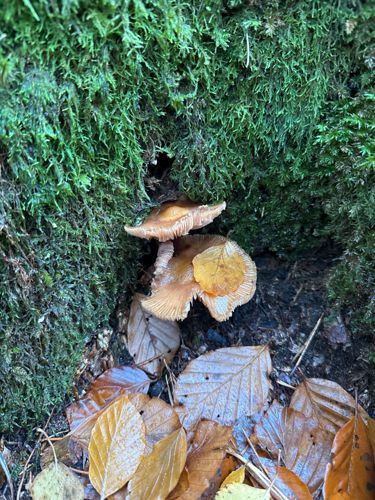
Physical Characteristics
The cap of Flammulina velutipes typically ranges from 2-10 cm in diameter, is convex to broadly convex or nearly flat, and can be orange-yellow to reddish-brown, often darker in the center. It is distinctively sticky or slimy when moist, becoming shiny when dry. The gills are adnate to adnexed, broadly spaced, and whitish to pale yellow. The stem is slender, tough, often velvety and dark brown to blackish at the base, becoming lighter (yellowish to brownish) towards the cap, ranging from 3-10 cm in length and 0.3-1 cm in thickness. Spore print is white to creamy yellow.
Habitat & Growing Conditions
It is a saprobic fungus, meaning it feeds on dead organic matter. It commonly grows in clusters on dead or living deciduous wood (especially elm, beech, oak, and willow) and occasionally on conifers. It can also appear at the base of trees or on stumps and logs.
Season & Fruiting Time
This mushroom is notable for its late fruiting season, primarily found from late autumn through winter and even into early spring, often tolerating frost and thawing conditions.
Similar Looking Species
Similar looking species include Galerina marginata, which is deadly poisonous and typically grows on wood. Galerina marginata usually has a brown spore print (vs. white/creamy for Flammulina velutipes), a persistent ring on the stem, and lacks the sticky cap and velvety stem base of Flammulina velutipes. Gymnopilus penetrans can also look similar, but has rusty orange spores and a typically drier cap. Pholiota species also bear some resemblance but often have scales on the cap or stem and different gill and spore characteristics.
Ecological Role
Flammulina velutipes is a saprobic fungus, playing a crucial role in the decomposition of dead wood. By breaking down woody material, it helps recycle nutrients back into the ecosystem, contributing to forest health and nutrient cycling. It can also act as a weak parasite on living trees, especially those that are already stressed or weakened.
Safety reminder
AI mushroom identification is a best-effort estimate and can be wrong. Never use it to decide whether a mushroom is safe to handle or eat — always confirm with a qualified mycologist before any consumption.
Identified on: 10/25/2025
Mode: Standard