Bicolor Bolete, Two-colored Bolete
Baorangia bicolor (formerly Boletus bicolor)
Type: Bolete (Pored Mushroom)
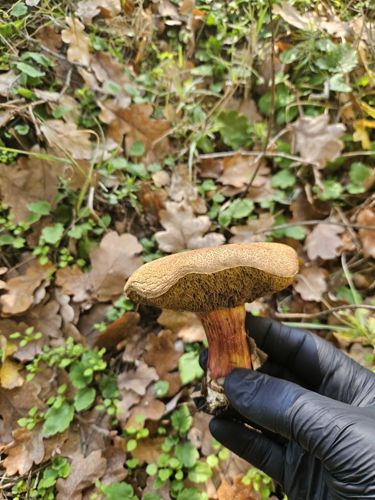
Physical Characteristics
Cap: Typically 5-15 cm wide, convex to broadly convex or flat. Color is ruby red to rose red, fading with age or sunlight to a rose-pink or yellow-red. Surface is dry and finely velvety when young, becoming smoother. Flesh is pale yellow, bruises blue faintly or not at all. Pores: Small, angular, and yellow to greenish-yellow. They often bruise blue upon handling. Stipe: 4-12 cm long and 1-3 cm thick, solid, often red over a yellow ground color, particularly towards the base, or entirely red. It can be smooth or finely reticulate (net-like) at the apex. Spore print: Olive-brown.
Habitat & Growing Conditions
Mycorrhizal with hardwoods, especially oak. Found growing solitarily or scattered on the ground in deciduous and mixed hardwood forests.
Season & Fruiting Time
Summer and early autumn.
Similar Looking Species
There are several boletes that can appear similar. 'Boletus sensibilis' is a look-alike that bruises strongly blue immediately. 'Boletus miniato-olivaceus' has a olive-yellow cap and red stipe. 'Boletus pulverulentus' bruises very quickly and intensely blue, and has a yellow-brown to olive-brown cap. 'Boletus edulis' (Porcini) has white or pale pores when young, not yellow, and a different stipe ornamentation.
Ecological Role
Mycorrhizal, forming a symbiotic relationship with trees, notably oak, by facilitating water and nutrient absorption for the tree in exchange for carbohydrates. This contributes to the health and growth of its host trees and the forest ecosystem.
Safety reminder
AI mushroom identification is a best-effort estimate and can be wrong. Never use it to decide whether a mushroom is safe to handle or eat — always confirm with a qualified mycologist before any consumption.
Identified on: 11/3/2025
Mode: Standard