Clustered Bonnet
Mycena inclinata
Type: gilled mushroom
Physical Characteristics
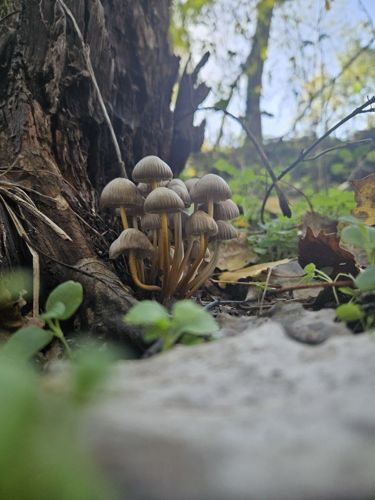
The caps are conical to bell-shaped, often with a central papilla, and measure 1-4 cm in diameter. Their color can vary from grayish-brown to reddish-brown, often fading to a lighter color at the margin, and they can have radial striations when moist. The gills are adnate to nearly free, closely spaced, and whitish to grayish with reddish-brown spots or margins in older specimens. The stipe (stem) is slender, hollow, typically 4-10 cm long and 2-5 mm thick, starting whitish at the apex and becoming yellow-brown to reddish-brown towards the base, often covered in fine hairs. The spore print is white.
Habitat & Growing Conditions
Typically found growing in dense clusters on dead hardwood stumps, logs, and decaying wood, especially oak. It is a common species in deciduous and mixed forests.
Season & Fruiting Time
Mainly found in late summer and autumn, roughly from August to November, thriving in cool, moist conditions.
Similar Looking Species
Several other Mycenas can look similar, making identification challenging. Mycena galericulata (Rosy Bonnet) is generally larger, often solitary or in smaller groups, and lacks the reddish-brown staining on the gills. Mycena haematopus (Bleeding Mycena) is distinguished by secreting a reddish liquid when cut. Careful examination of microscopic features and spore characteristics is often necessary for definitive identification within the genus.
Ecological Role
Mycena inclinata is a saprophytic fungus, playing a crucial role in the decomposition of dead wood, particularly hardwood. It breaks down complex organic matter, returning nutrients to the ecosystem and contributing to soil health. This process is vital for nutrient cycling in forests.
Safety reminder
AI mushroom identification is a best-effort estimate and can be wrong. Never use it to decide whether a mushroom is safe to handle or eat — always confirm with a qualified mycologist before any consumption.
Identified on: 11/13/2025
Mode: Standard