Death Cap
Amanita phalloides
Type: gilled mushroom
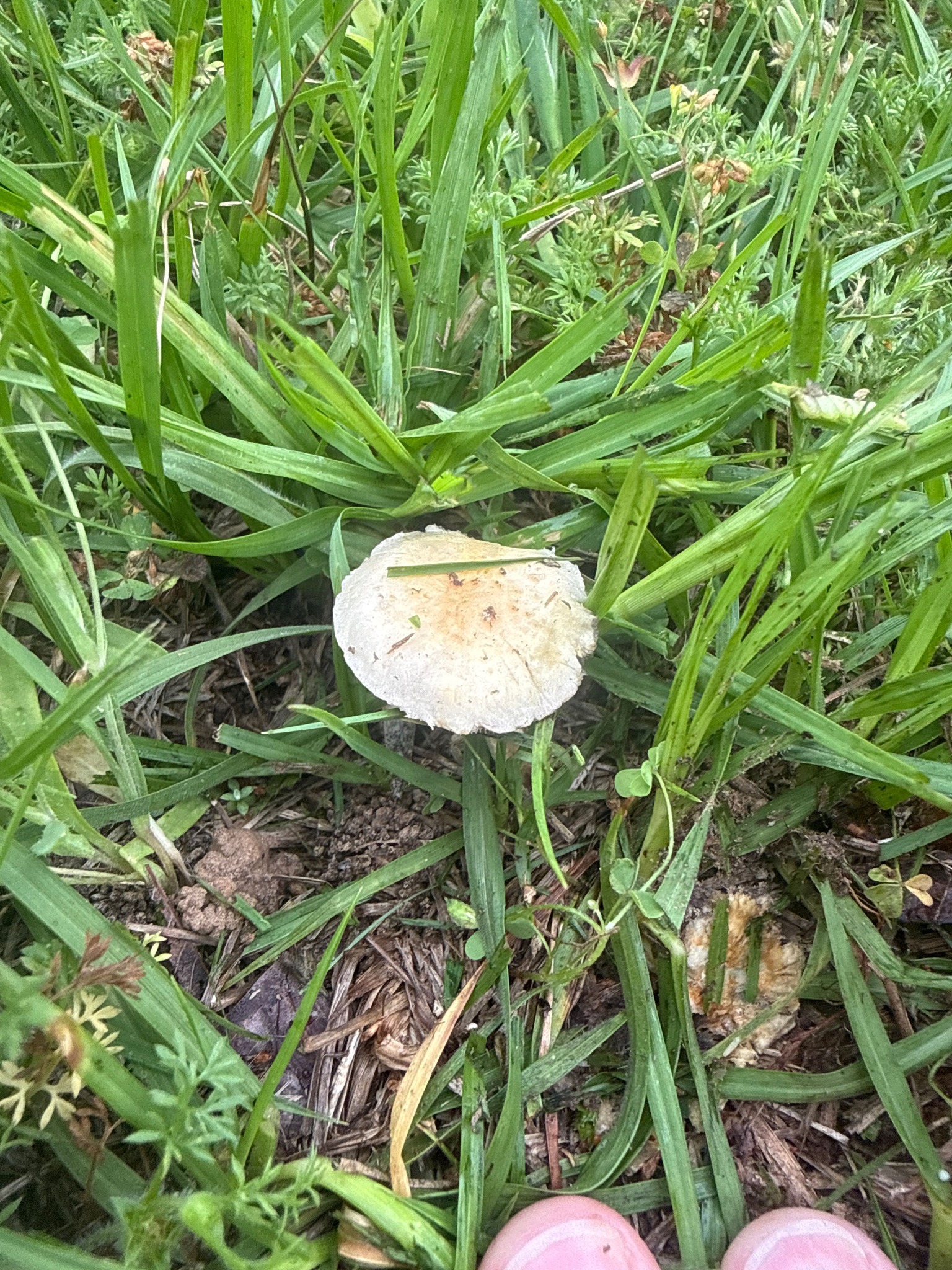
Physical Characteristics
Convex to flat cap, often with a slight greenish or yellowish tint, becoming paler toward the edge. It features white gills that are free from the stem, a prominent ring (annulus), and a large sack-like base (volva).
Habitat & Growing Conditions
Found on the ground in association with broadleaf trees, especially oak and beech, though it can occur with some conifers. It prefers woodland edges and landscaped areas.
Season & Fruiting Time
Typically appears from late summer to late autumn, especially following periods of heavy rain.
Similar Looking Species
Amanita bisporigera (Destroying Angel), Amanita citrina (False Death Cap), and some species of Agaricus (which lack a volva and have dark spores) or Volvariella (which lack a ring and have pink spores).
Ecological Role
Mycorrhizal, forming a symbiotic relationship with the roots of certain trees to exchange nutrients and water.
Fruiting Body
Cap is 5–15 cm wide, smooth, sticky when wet, metallic-olive to greenish-yellow. Hymenophore consists of crowded white gills. Stipe is 8–15 cm long, white to pale olive, often with a skirt-like ring and a bulbous base encased in a white membranous volva.
Size
Cap diameter: 5–15 cm; Stipe length: 8–15 cm, thickness 1–2 cm.
Spore Print
White
Distribution
Native to Europe, but widely introduced and established in North America, North Africa, and parts of the Southern Hemisphere including Australia and New Zealand.
Identification Tips
Check for white gills, a ring on the stem, and the presence of a cup-like volva at the very base of the stem (often buried). The cap often has a characteristic feathery, radial fiber texture under a lens.
Interesting Facts
This species was first described by French botanist Sébastien Vaillant in 1727. It is one of the most studied fungi in the world because of its potent biochemistries, including alpha-amanitin, which inhibits RNA polymerase II.
Safety reminder
AI mushroom identification is a best-effort estimate and can be wrong. Never use it to decide whether a mushroom is safe to handle or eat — always confirm with a qualified mycologist before any consumption.
Identified on: 4/18/2026
Mode: Standard