Ink Cap
Coprinopsis atramentaria
Type: gilled mushroom
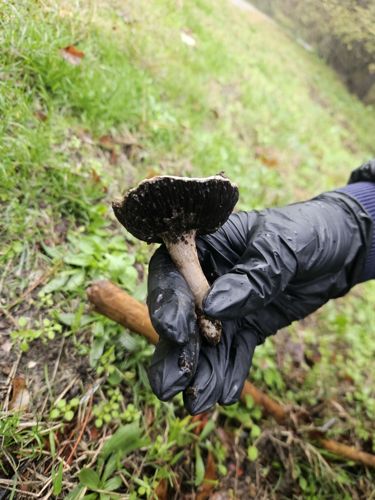
Physical Characteristics
The cap is typically ovoid to campanulate (bell-shaped) when young, expanding to conical or plano-convex with age, often with a fibrillose or scaly surface. It can be grayish-brown to grayish-black, often darker at the center and lighter towards the margin. The gills are crowded and free, starting whitish, then turning pinkish, then black, and finally deliquescing (dissolving into an inky black liquid). The stem is typically whitish, sometimes with a transient ring or ring zone, and can be hollow. Spore print is black.
Habitat & Growing Conditions
Found in clusters or groups on disturbed ground, rich soil, grass, wood debris, or decaying wood, often in urban areas, gardens, meadows, and along roadsides. It is a saprobic species.
Season & Fruiting Time
Commonly found from spring through autumn, especially after rain.
Similar Looking Species
Other Ink Cap species (Coprinopsis spp., Coprinellus spp., Coprinus spp.) can look similar. Distinguishing features often involve microscopic analysis, cap surface characteristics, and habitat. For example, some 'magpie inkcaps' (Coprinopsis picacea) have distinct scales, and the Common Ink Cap (Coprinellus micaceus) is typically smaller and has a mica-like shimmering cap.
Ecological Role
This mushroom is saprobic, meaning it obtains nutrients by decomposing dead organic matter. It plays an important role in nutrient cycling, breaking down complex organic compounds in soil and wood, thus contributing to the health of ecosystems.
Safety reminder
AI mushroom identification is a best-effort estimate and can be wrong. Never use it to decide whether a mushroom is safe to handle or eat — always confirm with a qualified mycologist before any consumption.
Identified on: 11/3/2025
Mode: Standard