Gray Shag mushroom
Coprinopsis cinerea
Type: Gilled Mushroom
Physical Characteristics
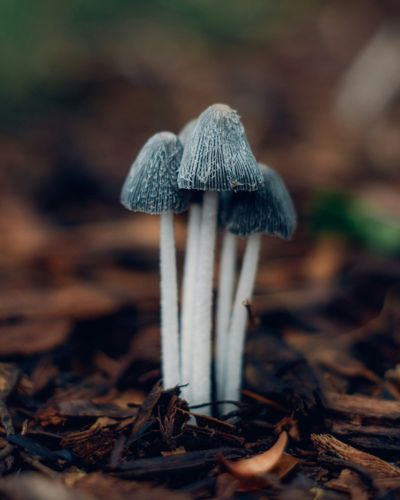
The mushrooms in the image appear to be small to medium-sized with conical to bell-shaped caps, grayish in color, and distinctly grooved or plicate (having radiating folds or pleats). The caps seem delicate and may be covered in fine, powdery substance or fibrils, typical of certain Coprinopsis species when young. The stems are slender, white, and relatively uniform in thickness, supporting the caps. They seem to be growing in clusters, a common growth habit for these types of fungi. The gills are not clearly visible but would be crowded under the cap.
Habitat & Growing Conditions
The mushrooms are growing directly out of wood chips or mulch, indicating a preference for decomposed woody substrates. They are commonly found in gardens, cultivated areas, disturbed ground, or areas with wood debris.
Season & Fruiting Time
These mushrooms are typically found from spring to autumn, often appearing after rain. Their growth is favored by warm, humid conditions.
Similar Looking Species
Similar species include other Coprinopsis species, such as Coprinopsis lagopus (Hare's Foot Inkcap) or Coprinopsis atramentaria (Common Ink Cap). Coprinopsis lagopus shares the delicate, gray, shaggy appearance but often has a more pronounced shaggy cap. Coprinopsis atramentaria is generally larger and more robust, with a grayer cap that deliquesces (dissolves into black ink) more readily. Distinguishing between specific Coprinopsis species often requires microscopic examination of spores and other features.
Ecological Role
This mushroom is saprophytic, meaning it obtains nutrients by decomposing dead organic matter. It plays a crucial role in nutrient cycling in its habitat by breaking down wood chips, leaf litter, and other organic debris, returning essential nutrients to the soil and facilitating plant growth.
Safety reminder
AI mushroom identification is a best-effort estimate and can be wrong. Never use it to decide whether a mushroom is safe to handle or eat — always confirm with a qualified mycologist before any consumption.
Identified on: 7/20/2025
Mode: Standard