Slippery Jack
Suillus luteus
Type: Boletus mushroom
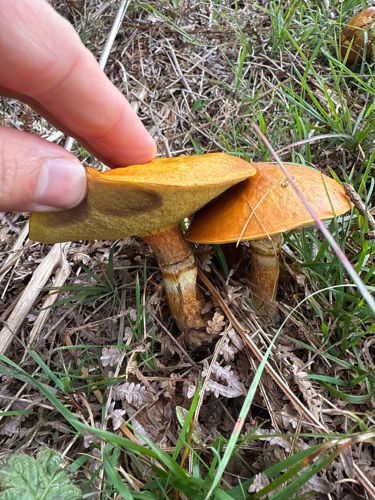
Physical Characteristics
Cap: 5-15 cm in diameter, convex to broadly convex or almost flat, viscid (slimy) when moist, typically yellowish-brown to dark brown, sometimes with purplish or reddish tints. Pores: Adnate to slightly decurrent, small, circular, and yellow, turning olive-yellow with age. Stem: 3-10 cm long, 1-3 cm thick, solid, yellowish to brownish, often with a prominent purplish-brown ring (annulus) which is a remnant of the partial veil. The area above the ring is usually paler than below. Spore print: Olive-brown to brown.
Habitat & Growing Conditions
Found exclusively in association with pine trees, forming a mycorrhizal relationship. It can be found in pine forests, plantations, and parks, often growing in clusters.
Season & Fruiting Time
Late summer to autumn, and sometimes into early winter in milder climates, especially after periods of rain.
Similar Looking Species
Several other species within the genus Suillus can look similar. Suillus granulatus (Granulated Bolete) lacks a ring on the stem and has glandular dots on the stem. Suillus Grevillei (Larch Bolete) grows exclusively with Larch trees and often has a more yellowish-orange cap. Close inspection of the presence or absence of a ring and host tree association is key for differentiation.
Ecological Role
Mycorrhizal, forming a symbiotic relationship with pine trees. The fungus provides the tree with increased water and nutrient uptake, while the tree provides the fungus with carbohydrates produced through photosynthesis. This relationship is crucial for the health and growth of pine forests.
Safety reminder
AI mushroom identification is a best-effort estimate and can be wrong. Never use it to decide whether a mushroom is safe to handle or eat — always confirm with a qualified mycologist before any consumption.
Identified on: 10/13/2025
Mode: Standard