Velvet Shank
Flammulina velutipes
Type: gilled mushroom
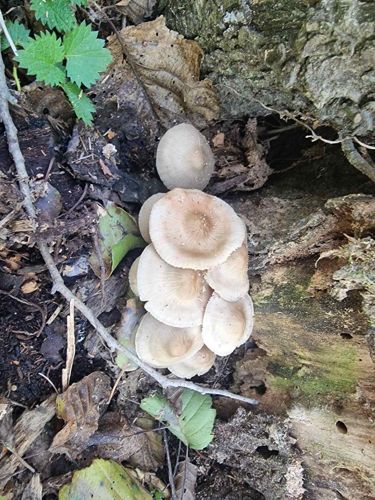
Physical Characteristics
The cap is typically 2-10 cm wide, convex to flat, often sticky or slimy when moist, varying in color from yellow-orange to reddish-brown, often darker towards the center. The gills are attached, broad, and whitish to pale yellow. The stem is slender, tough, often velvety, darkening from yellow or orange at the top to dark brown or black at the base, and can be 3-10 cm long. It does not have a ring. The spore print is white to cream.
Habitat & Growing Conditions
This mushroom is saprobic, growing in clusters or singly on dead or decaying hardwood logs and stumps, especially elm, oak, and beech. It can also appear on living but damaged trees.
Season & Fruiting Time
Late autumn through winter, and sometimes into early spring, often fruiting even through snow and freezing temperatures.
Similar Looking Species
Similar looking species include some other clustered brown-capped fungi. Galerina marginata (Deadly Galerina) is a deadly poisonous mushroom that can look superficially similar, particularly common on wood. Key differences include Galerina having a persistent ring on the stem, not growing in cold weather, and having a rusty brown spore print. Another similar species, though less dangerous, is the Winter Pholiota (Pholiota adiposa), which has yellowish to brownish caps covered in scales and a ring.
Ecological Role
Flammulina velutipes is a saprobic fungus, playing a crucial role in the decomposition of dead hardwood, breaking down complex organic matter and recycling nutrients back into the ecosystem.
Safety reminder
AI mushroom identification is a best-effort estimate and can be wrong. Never use it to decide whether a mushroom is safe to handle or eat — always confirm with a qualified mycologist before any consumption.
Identified on: 11/3/2025
Mode: Standard