Mycena
Mycena species
Type: gilled mushroom
Physical Characteristics
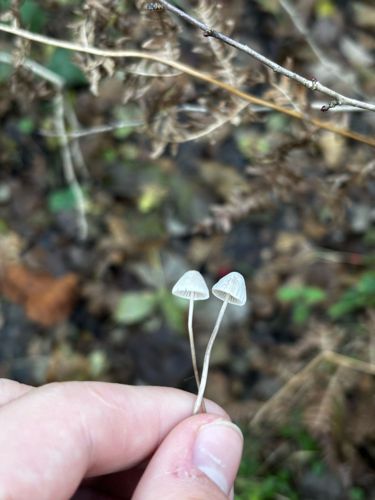
These are very small, delicate mushrooms. The caps are conical to bell-shaped, often translucent or whitish, showing the gill lines through the cap surface. They are typically striate (grooved) from the margin towards the center due to the gills beneath. The gills are adnexed or free, white to pallid. The exact spore print color is difficult to determine from the image but would likely be white. The stipe (stem) is very slender, fragile, and often translucent or whitish, equal in width throughout.
Habitat & Growing Conditions
Mushrooms of the genus Mycena typically grow saprophytically on decaying organic matter, such as leaf litter, moss, or decaying wood (often buried or highly decomposed). They are common in damp, shaded areas of forests, woods, and occasionally gardens, often found in clusters or scattered.
Season & Fruiting Time
Mycena species can be found throughout the year, depending on the specific species and local climate, but they are most commonly observed during periods of high humidity and moderate temperatures, typically from late spring through autumn, and even into mild winters in some regions.
Similar Looking Species
There are numerous small, delicate white Mycena species that look very similar, making exact identification without microscopic examination challenging. Distinguishing features often involve microscopic characteristics such as spore shape, cystidia, and gill structure. Macroscopically, variations in cap shape, striations, and presence of any viscid (slimy) cap surface can help. Other small, white gilled mushrooms might be confused, but Mycena species are generally characterized by their fragility and often translucent appearance.
Ecological Role
Fungi in the Mycenaceae family are primarily saprophytic, meaning they obtain nutrients by decomposing dead organic matter. This species likely plays a significant role in nutrient cycling in its habitat by breaking down fallen leaves, twigs, and other woody debris, returning essential nutrients to the soil. They contribute to forest floor decomposition.
Safety reminder
AI mushroom identification is a best-effort estimate and can be wrong. Never use it to decide whether a mushroom is safe to handle or eat — always confirm with a qualified mycologist before any consumption.
Identified on: 7/22/2025
Mode: Standard