Parasol Mushroom
Macrolepiota procera
Type: Gilled mushroom
Physical Characteristics
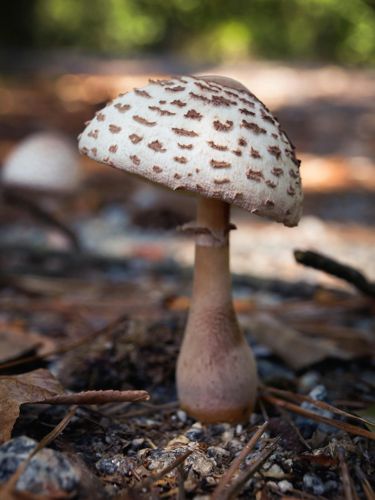
Cap: Initially egg-shaped, expanding to convex then flat, typically white to cream with brownish to reddish-brown, shaggy scales often concentrated towards the center. Gills: Free, crowded, white to cream, sometimes staining reddish with age or handling. Stem: Pale, often with a bulbous base, typically fibrous and separating easily from the cap. A prominent, movable ring is present, often discolored brown from spores. Spore print: White. Size: Caps can range from 10-30 cm (4-12 inches) in diameter, with stems up to 40 cm (16 inches) tall.
Habitat & Growing Conditions
Found growing solitarily or in scattered groups on the ground in woodlands, forests (especially coniferous and mixed woods), gardens, meadows, and along roadsides. It often appears in disturbed areas or where there is abundant decaying organic material. It does not grow directly on wood.
Season & Fruiting Time
Typically found from late summer through autumn, often peaking after periods of rain.
Similar Looking Species
Similar species include other members of the genus Macrolepiota, such as Macrolepiota rhacodes (often called the Shaggy Parasol) which has a sturdier, often darker stem and tends to bruise reddish-orange when handled. Chlorophyllum molybdites (the Green-spored Parasol) is another look-alike, distinguishable by its greenish spore print in maturity and generally lacks the prominent shaggy scales of Macrolepiota procera on the cap.
Ecological Role
This mushroom is saprophytic, obtaining nutrients from decaying organic matter in the soil. It plays an important role in decomposition, breaking down leaf litter and other dead plant material, thereby recycling nutrients back into the ecosystem.
Safety reminder
AI mushroom identification is a best-effort estimate and can be wrong. Never use it to decide whether a mushroom is safe to handle or eat — always confirm with a qualified mycologist before any consumption.
Identified on: 7/20/2025
Mode: Standard