Gem-studded Puffball
Lycoperdon perlatum
Type: Puffball
Physical Characteristics
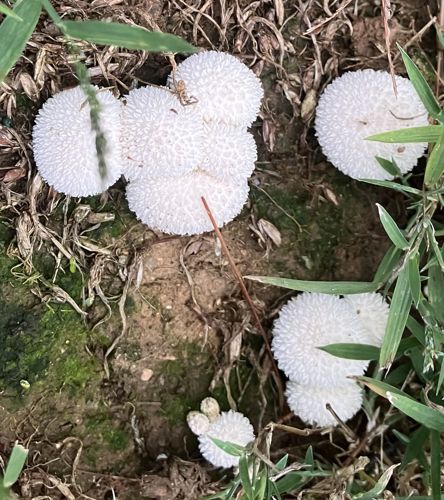
The fruit body is typically pear-shaped, 3 to 7 cm tall and 2 to 6 cm wide, with a tapered base. The surface is white to cream-colored and covered with short, pointed warts or 'gems' that can be easily rubbed off, leaving behind a smooth, net-like pattern. As it matures, the color may change to yellowish-brown. The interior of young puffballs is white and firm; in older specimens, it becomes a yellowish-green to olive-brown powdery mass of spores. It has a small opening at the top when mature to release spores.
Habitat & Growing Conditions
Found widely in hardwood and coniferous forests, often in disturbed areas, along roadsides, and in grassy clearings. It grows terrestrially on soil, decaying wood, or in leaf litter, solitary to gregariously (in groups).
Season & Fruiting Time
Typically found from summer through autumn, often after periods of rain. In some temperate regions, it can be found from late spring to early winter.
Similar Looking Species
Similar looking species include other puffballs such as 'common puffball' (Lycoperdon pyriforme), which often grows on wood and lacks the prominent 'gems', and 'wolf-fart puffball' (Lycoperdon excipuliforme), which is generally larger and has a more elongated base. Distinguishing features are the gem-like warts that rub off easily to leave a reticulate (net-like) pattern.
Ecological Role
This species is saprophytic, meaning it obtains nutrients by breaking down dead organic matter. It plays an important role in nutrient cycling in its ecosystem, decomposing fallen leaves, branches, and other organic debris, thus returning essential nutrients to the soil.
Safety reminder
AI mushroom identification is a best-effort estimate and can be wrong. Never use it to decide whether a mushroom is safe to handle or eat — always confirm with a qualified mycologist before any consumption.
Identified on: 9/29/2025
Mode: Standard