Parasol Mushroom
Macrolepiota procera
Type: gilled mushroom
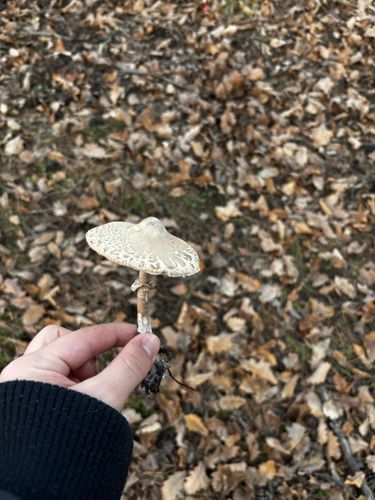
Physical Characteristics
The parasol mushroom (Macrolepiota procera) is characterized by its large cap, typically 10-30 cm in diameter, which starts egg-shaped or bell-shaped and flattens out with age, retaining a prominent central umbo (a raised nipple-like structure). The cap surface is whitish to light brown, covered with concentric rings of dark, shaggy, and often uplifted scales, giving it a distinctive patterned appearance. The gills are free (not attached to the stem), crowded, white to cream-colored, and may develop reddish stains with age or bruising. The stem is tall and slender, growing to 15-40 cm in height and about 1-2 cm in thickness, with a bulbous base. It has a distinctive double ring that is often movable along the stem. The stem surface is often mottled with brownish, snake-like patterns (a feature sometimes referred to as 'snakeskin' or 'tiger-stripe' pattern). The flesh is white and does not change color when cut. Spore print is white.
Habitat & Growing Conditions
The parasol mushroom is commonly found growing terrestrially (on the ground) in a variety of habitats, including woodlands (deciduous, coniferous, and mixed), forest edges, clearings, parks, gardens, and grasslands. It often appears in disturbed areas and prefers well-drained, nutrient-rich soil. It can grow solitarily or in scattered groups.
Season & Fruiting Time
Parasol mushrooms typically fruit from late summer through autumn, often appearing after periods of rain. Their fruiting season can extend into early winter in milder climates.
Similar Looking Species
Several other species can be confused with Macrolepiota procera. The most well-known is the False Parasol (Chlorophyllum molybdites), which is distinguished by its greenish spore print (versus white for M. procera), and gills that turn greenish with maturity. Chlorophyllum rhacodes (Shaggy Parasol) is another similar species, often found in similar habitats, but it bruises reddish-brown when cut or handled and has a single, often less defined ring. Leucoagaricus leucothites (Smooth Parasol) is smaller, has a smooth cap, and lacks the scaly pattern and snake-skin stem. Careful observation of cap scales, ring structure, gill color changes, and especially spore print color are essential for accurate identification and differentiation from similar species, some of which may be toxic.
Ecological Role
Macrolepiota procera is a saprophytic fungus, meaning it obtains nutrients by decomposing dead organic matter. It plays a crucial role in nutrient cycling in woodlands and grasslands by breaking down leaf litter, wood debris, and other organic material, returning essential nutrients to the soil. Its decomposition activities contribute to soil health and fertility, supporting plant growth and overall ecosystem functionality.
Safety reminder
AI mushroom identification is a best-effort estimate and can be wrong. Never use it to decide whether a mushroom is safe to handle or eat — always confirm with a qualified mycologist before any consumption.
Identified on: 7/22/2025
Mode: Standard