Angel's Bonnet
Mycena arcangeliana
Type: gilled mushroom
Physical Characteristics
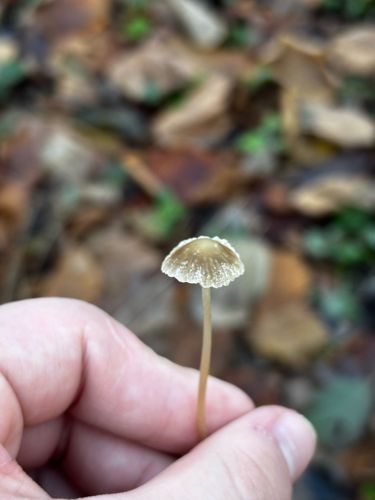
The cap of Mycena arcangeliana is typically bell-shaped to conical, becoming more convex with age, often with a small central umbo or nipple. It can range in color from pale yellowish-brown to olive-brown or grayish-brown, often darker towards the center. The cap surface is smooth, sometimes striate or translucent-striate near the margin, especially when moist. A distinctive feature is the presence of fine, sparkling granules ( pruina) on the cap surface, which are more visible when young or under magnification. The gills are adnate to adnexed, somewhat crowded, and typically pale gray to whitish, sometimes with a yellowish tint. The stem is thin, fragile, cylindrical, and can be whitish, yellowish, or brownish, often with a slightly darker base. It may be translucent and is usually smooth. The size of the cap is generally small, ranging from 0.5 to 2.5 cm in diameter, and the stem is usually 2-8 cm in height and 0.1-0.3 cm thick. The spore print color is white.
Habitat & Growing Conditions
This mushroom typically grows solitarily or in small scattered groups on leaf litter, woody debris, or mossy ground in broadleaf and mixed woodlands. It shows a preference for damp, shady conditions and often fruits on well-decayed wood or rich humus. It can be found on a variety of tree species, but often associated with fallen leaves and branches.
Season & Fruiting Time
Mycena arcangeliana is most commonly found during autumn, from late summer through late fall, when conditions are cool and moist. In some regions with mild winters and consistent moisture, it might be observed into early winter.
Similar Looking Species
Mycena arcangeliana can be confused with other small, unassuming species within the genus Mycena, which is a very diverse and challenging group to identify without microscopic examination. Some species like Mycena galericulata or Mycena filopes can appear similar in general form, but M. arcangeliana is often distinguished by the presence of a faint yellowish or olive tint, especially in the cap, and the distinct pruinose (finely granular or hoary) appearance on the cap surface. Unlike M. arcangeliana, many other Mycena species do not exhibit this pruinose texture as prominently. The small size and often translucent-striate cap are common among many Mycena species, making careful observation of subtle color differences, surface textures, and any associated odors—though not always reliable—important for differentiation. Microscopic features, particularly spore shape and size, and the structure of cystidia, are often necessary for definitive identification within the genus.
Ecological Role
Mycena arcangeliana is a saprophytic fungus, playing a crucial role as a decomposer in woodland ecosystems. It obtains nutrients by breaking down dead organic matter, primarily fallen leaves, woody debris, and other plant material. By decomposing these materials, it recycles essential nutrients back into the soil, making them available for other plants and organisms, thus contributing to nutrient cycling and maintaining a healthy forest floor. Its activity helps in the natural decomposition process, preventing excessive accumulation of leaf litter.
Safety reminder
AI mushroom identification is a best-effort estimate and can be wrong. Never use it to decide whether a mushroom is safe to handle or eat — always confirm with a qualified mycologist before any consumption.
Identified on: 7/22/2025
Mode: Standard