Fly Agaric
Amanita muscaria
Type: gilled mushroom
Physical Characteristics
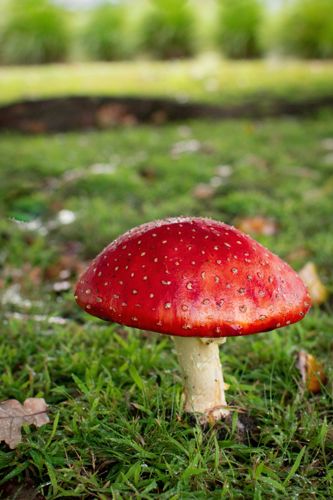
The cap of *Amanita muscaria* is typically bright red to orange-red, often covered with distinctive white or yellowish warts (remnants of the universal veil). It can range from about 8 to 20 cm (3 to 8 inches) in diameter, starting as a sphere and flattening with age. The gills are white, crowded, and free from the stem. The stem (stipe) is white or yellowish, 5 to 20 cm (2 to 8 inches) high, with a distinctive skirt-like ring (annulus) that often has a ribbed appearance. The base of the stem is bulbous, with concentric rings or scales, also remnants of the universal veil. The spore print is white.
Habitat & Growing Conditions
This species is commonly found growing on the ground in woodlands and forests, particularly under conifers and broadleaf trees. It grows singly or in scattered groups.
Season & Fruiting Time
It is typically found in late summer and autumn, extending into early winter in some regions, depending on local climate conditions.
Similar Looking Species
*Amanita muscaria* can sometimes be confused with other species, particularly other red-capped *Amanita* species or even some species of *Russula*. Key distinguishing features include its prominent white warts on the cap, the specific nature of its partial veil (forming the ring), and the volva remnants at the base of the stem (often appearing as concentric rings or scales). The bright red color with white flakes is quite distinctive, though color can vary with regional varieties (e.g., *Amanita muscaria* var. *formosa* has a more orange-yellow cap) or age, and environmental conditions can cause warts to wash off.
Ecological Role
Amanita muscaria is a well-known ectomycorrhizal fungus. It forms a symbiotic relationship with the roots of various trees, especially conifers (like pine, spruce, fir) and broadleaf trees (like birch and oak). In this relationship, the fungus helps the tree absorb water and nutrients from the soil, while the tree provides the fungus with carbohydrates produced through photosynthesis. This mutualistic relationship is vital for the health and growth of many forest ecosystems.
Safety reminder
AI mushroom identification is a best-effort estimate and can be wrong. Never use it to decide whether a mushroom is safe to handle or eat — always confirm with a qualified mycologist before any consumption.
Identified on: 7/20/2025
Mode: Standard