Panaeolus foenisecii
Panaeolus foenisecii
Type: gilled mushroom
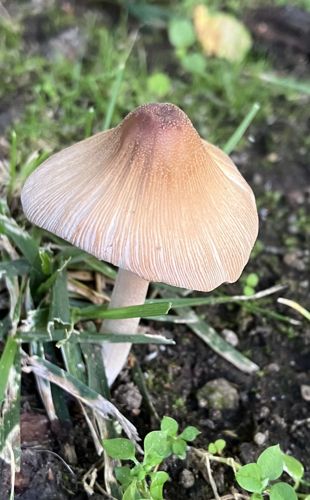
Physical Characteristics
The photo shows a mushroom with a conical to campanulate (bell-shaped) cap that is radially striate (grooved) and light tan to brown, with a darker brown umbo (central raised part). The stipe (stem) appears slender and off-white. Gills are visible under the cap, appearing adnate (attached to the stem).
Habitat & Growing Conditions
This mushroom is likely found growing terrestrially in grassy areas, gardens, or disturbed ground, often in rich soil or on decaying organic matter. Psathyrella species are common in lawns, along roadsides, and in woodland edges.
Season & Fruiting Time
Panaeolus foenisecii is typically found from spring through autumn, especially after rain, and can persist into early winter in some regions. It often fruits in flushes during periods of warm and moist weather.
Similar Looking Species
Similar looking species include other Panaeolus species, such as Panaeolus papilionaceus, which often has a more pronounced cap margin and darker spores. Some species of Psathyrella can also look similar, but generally, their caps are more brittle. Distinguishing features include the brown, often mottled cap, and fine striations, along with its specific growth habitat.
Ecological Role
Psathyrella mushrooms are primarily saprophytic, meaning they obtain nutrients by decomposing dead organic matter such as wood, leaf litter, and other plant debris. They play a crucial role in nutrient cycling in their ecosystems by breaking down complex organic compounds, making nutrients available for other organisms.
Safety reminder
AI mushroom identification is a best-effort estimate and can be wrong. Never use it to decide whether a mushroom is safe to handle or eat — always confirm with a qualified mycologist before any consumption.
Identified on: 7/24/2025
Mode: Standard